How to Learn Complex Material Quickly

Posted on Leave a commentPosted in Dev Diary

Dev Diary posts are made to teach game development through specific examples from my latest project: Highways & Byways.

Just here for Highways & Byways updates? Click here – it will take you right to the updates at the bottom of the page.


Over the course of the last week, I’ve taken a bit of a left turn in the development of Highways & Byways. Instead of focusing directly on game development, I’ve focused on learning as much as I can about board games. That includes popular games, mechanics, and themes; well-known designers; and how to run a successful Kickstarter. I’ve advocated before the importance of ongoing training, and I’ve focused very heavily on it myself this week.

Looking for more resources to help you on your board game design journey?
Here you go: no email required!

Like this writing style?
Check out my latest blog on marketing here.

Why go to all this trouble? A lot of new designers see that I’ve published War Co. and imagine that future Kickstarters will just be more successful from there. Future games will be better by the mere act of having experienced the development process before and being aware of some of the pitfalls and opportunities to be more productive. My community continues to grow. This is all true, but I see room (read: a vast expanse) to improve even still. Experience gives you advantage, but it cannot substitute for systematic book learning. If you want to get better at something, you have to continually and thoughtfully work for it.

With this in mind, I’d like to share with you a learning technique that I came up with late in my undergraduate studies. Ever since I developed it, I got A’s in all my classes for the rest of undergrad and grad school. It didn’t take nearly as much work as you’d think, either. I didn’t do anything particularly special. This technique is something that you can apply to almost anything you’re interested in and see similarly positive results.

Studying Dog with Glasses
Study hard and you won’t have to work like a dog later.

The Study Technique

1. Find primary resources. In school, primary resources were textbooks and lectures. In the world at large, primary sources can include all sorts of things: data from your business, academic journals, videos, blogs, magazines, news sites, social media, books, and so on.

2. Read the Overview so you so you know what to expect. The Overview could be an actual overview paragraph, a summary section, a Table of Contents, a list of blog articles, or the abstract of an academic article. Sometimes this is not available, but in long-form material, it usually is.

3. Read the primary resources all the way through, slowly, taking in every word. Take it slow and stay focused. Pay attention to every word and every image. Don’t get too mired down in the details, but take in as much as you can the first time.

4. Start taking notes. Go through the entire resource and start taking notes on your computer. Every header, every definition, every bit of bolded text, every numbered list, every bulleted list, and every sentence that looks generally important should be in the notes. Adapt these rules to the medium you’re pulling information from. There are signals of important information in anything you pay attention to.

5. Read the notes once every day, even if it’s speedreading.

6. Bonus: make flash cards and start memorizing your notes. You can use a tool such as Quizlet to make flash cards online. For most situations, this is overkill, but it works really well in school and in high-pressure situations.

Study Materials

This is a time-consuming, difficult, painfully boring technique, but I promise that in can save you time, difficulty, and boredom in the long run. In school, I cut my study time by about 25% and my grades went up.

It’s not just for textbooks, though. You can apply this to a variety of skills if you choose your sources wisely. Want to learn cooking? Use this technique with a cookbook. Want to learn home repair? Use this technique with a home repair podcast.

Want to learn game development? Use BoardGameGeek’s database, blogs such as Stonemaier Games Kickstarter Lessons, Dice Tower videos, design books such as the Kobold Guide to Board Game Design, and even academic research papers (which you can find on Google Scholar). Obviously, you still need to be experimenting and developing your own games, but this information will help you get to the next level in your development.

The repetition and hard work are half of what makes this technique work. The other half is that its designed to help you gather and remember only the most important information. We can’t remember everything, so we must be careful to remember the right things.


Key Takeaways for Game Devs

  • Experience gives you advantage, but it cannot substitute for systematic book learning.
  • Periodically focusing on ongoing training can make you a better development.
  • You can use the same study technique I used to get A’s in grad school to learn game development.
  • The study technique:


    • Find primary sources


    • Read the overview of each source


    • Read the entire primary source all the way through slowly


    • Take detailed notes on each source


    • Study the notes


    • Bonus: make flash cards and memorize the notes
  • Some good primary sources for game development: BoardGameGeek, Dice Tower videos, Stonemaier Games Kickstarter Lessons, the Kobold Book of Design, academic journals.

Most Important Highways & Byways Updates

  • Though I’ve primarily been studying game development this week, I’ve made quite a few updates on the game still.
  • I’ve updated the game to Version State Route 8, and it’ll probably be State Route 9 by tomorrow.
  • Rules have been cleaned up so I’m using consistent terminology.
  • I moved starting spaces around on the map so they’re more balanced.
  • I broke the hardest roads into two sections for both balance and simplicity.
  • My brother and I have play tested the game again and we agree that while it’s good, something is missing and we’re having trouble defining it.
  • I’ll be doing a “paper test” soon. I usually play test in Tabletop Simulator to save money, but I need to make sure the physical size of the board works as designed and I need to make sure it’s not too fiddly to play the game in real life. This is a necessity that comes with spending most of your time doing digital testing of a physical product.



5-Minute Dungeon: How to Make a Table Rowdy (And Why That’s a GREAT Thing)

Posted on 1 CommentPosted in Game Breakdown

A couple of weeks ago, I had the absolute pleasure of playing 5-Minute Dungeon at the friendly local gaming store for the first time. This game got us rowdier than ever before and it was awesome!

Looking for more resources to help you on your board game design journey?
Here you go: no email required!

Like this writing style?
Check out my latest blog on marketing here.

Originally from Kickstarter, this game is not as ubiquitous as the others I’ve covered in game breakdowns, so check out the Kickstarter and Board Game Geek pages to learn more. Needless to say, this game is definitely worth your time and attention. It’s holding a staggering 7.8 on Board Game Geek – a site where ratings over 8 are practically unheard of. Plus, I can personally vouch for it.

Photo taken by Stin Shen and posted to Flickr. It’s licensed under CC BY-NC-ND 2.0. (Source)

Not only is it worth our time and attention, it’s worth our study as well. 5-Minute Dungeon is a cooperative game where 2-5 players work together to clear dungeons and wreck bosses in just seven five minutes. The dungeon consists of a deck of cards that must be beaten in sequence. Each player has a deck of cards, from which they can only hold a few cards at a time. Players beat the dungeon cards by playing cards with symbols that match the symbols on the dungeon card. For example, if the dungeon card has three arrows and two shields, then all players must work together to pool three arrows and two shields. When this is done, you sweep your resources and the dungeon card aside and get to work on the next dungeon card. Repeat this process 20 or 30 or 40 times until the dungeon is clear. Then you have to beat the final boss, which requires more resources than a regular dungeon card. Beat the boss and stop the timer – if it hasn’t run out on you already!

While 5-Minute Dungeon is very simple, it’s also very engaging. The core engine of this game works beautifully. It would be a blast even without the bright art, consistent humor, and narration by Jon Bailey. That brings me to the crux of this game breakdown: 5-Minute Dungeon uses timing and cooperation to drive player engagement. Engagement is the bellwether of great games.

Engagement Driver 1: Use of a Timer

From a psychological standpoint, there are few things as powerful as a timer. Timers keep us focused. Timers keep us tapping our feet and shaking our legs up and down with anticipation. The beauty of 5-Minute Dungeon is that it doesn’t merely incorporate a cheesy little Pictionary sand timer. The timer is built into the name of the game. It even comes with a mobile app that displays the digital countdown in big and bright numbers that you can’t miss.

Sand timer? Oh no, my friend, 5-Minute Dungeon makes this look like ancient history. Photo taken by Neville Nel and posted to Flickr. It’s licensed under CC BY-NC-ND 2.0. (Source)

Of course, for game developers, adding a timer is often not an appropriate way to drive engagement. There are other great mechanics you can use. Part of the magic of 5-Minute Dungeon is not the use of a timer, but the showmanship around the use of the timer. It’s dramatic. It’s symbolic. You can feel it. Come up with something that works for your own game that’s dramatic, symbolic, and emotional.

Engagement Driver 2: The State of Flow

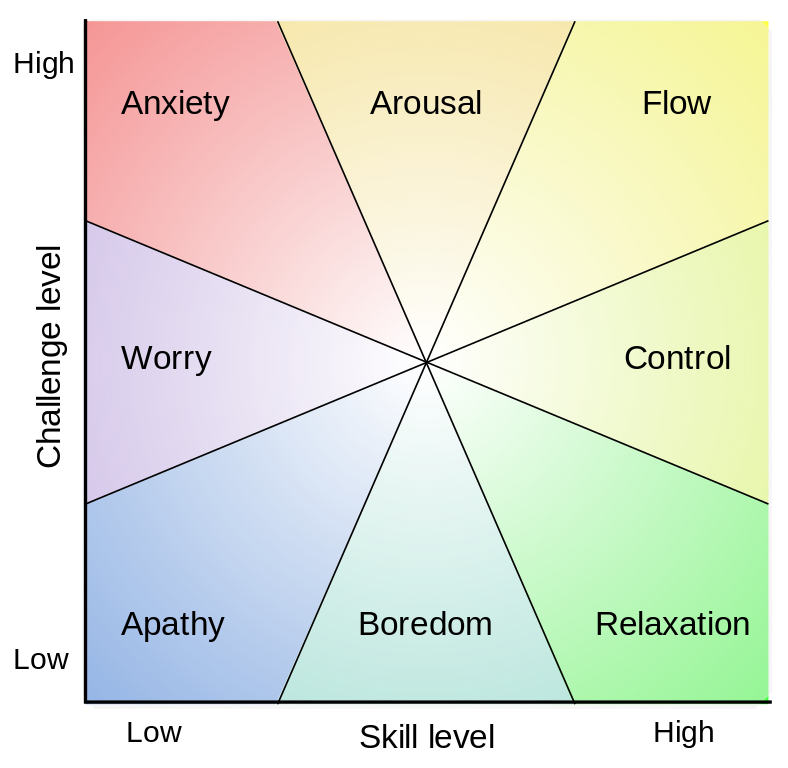
Mihaly Csikszentmihalyi Flow Model
Mihaly Csikszentmihalyi’s Flow Model

Flow, also known as the zone, is the mental state of operation in which a person performing an activity is fully immersed in a feeling of energized focus, full involvement, and enjoyment in the process of the activity. In essence, flow is characterized by complete absorption in what one does.

Pulled from the Wikipedia article on Flow (psychology)

Mihaly Csikszentmihalyi’s Flow Model is a favorite model of mine for approximating how engaging games are. Ideally, you want your game to keep players in a state of Flow, or at least Arousal, Control, or Relaxation the entire time. In 5-Minute Dungeon, players are in a constant state of flow.

If we take this model 100% literally, flow is caused by two things. One, a player must be challenged. Two, a player must feel like their skills are up to the task. Nothing in 5-Minute Dungeon is hard per se, so players feel like they can handle anything the game throws at them. After all, it’s nothing more than symbol matching! Yet when you add group dynamics and the timer, the challenge is quite formidable. Players are constantly analyzing what their teammates are doing and how that changes what needs to be done.

How do you know you’re in flow? It feels like you blink twice and an hour’s gone.

Engagement Driver 3: Good Housekeeping through Mechanics

The game is being constantly timed and players don’t have the opportunity to slip out of flow. The game’s structure has the pleasant effect of nipping two board game fun killers in the bud: analysis paralysis and long play times. 

While you can create rules that stave off analysis paralysis and limit times, they’re clumsy to implement. As a general rule of thumb in game design, you don’t want to do anything with rules that can be done by improving mechanics. There is no “after thirty seconds, the player forfeits their turn” or “a winner is decided after two hours” rule. The game is designed to never let that be an issue in the first place!

Engagement Driver 4: Simplicity for Newbies, Dexterity for Veterans 

Success in 5-Minute Dungeon depends upon quick thinking and cooperation. The game encourages division of labor and gradually ups dungeon difficulty to encourage this. The game is simple and lightweight, meaning players of any level of familiarity with board games can play. The challenge stems from communication and teamwork – not from memorizing rules or decoding awkward board symbols.


To bring it all together, 5-Minute Dungeon works because the core engine of the game is designed to be fast and engaging. It’s the sort of game that moves so quickly that decision anxiety and time constraints never pose problems. You play it, you get deeply in the zone, and completely wrapped up in it. That’s engagement, plain and simple. Engagement is a holy grail in board gaming.

Takeaways for Game Devs

  • 5 Minute Dungeon is a successful game because so many mechanics work toward the common goal of keeping players engaged in the game.
  • High player engagement is achieved because the game requires quick thinking and cooperation.
  • Using a timer puts players in a state of flow, kills analysis paralysis, and prevents the game from running long.
  • 5 Minute Dungeon has simple mechanics and simple rules, which allows gamers of different levels of familiarity with board games to play well.
  • The game gradually raises difficulty, which allows players to organically learn and grow.


What’s the point of board game reviews?

Posted on Leave a commentPosted in Philosophy

One of the most jarring experiences for new game developers is the process of getting their game reviewed. Oh, the pain of sending your precious brainchild to someone to publicly judge! Drama aside, it truly is difficult at first because you have to identify reviewers, send prototypes, make sure your game is ready enough, cross your fingers, and hope they like it. Sometimes you even have to compensate the biggest names for their time and effort.

Courtroom Gavel Judgement
This court finds the board game…not playable!

Looking for more resources to help you on your board game design journey?
Here you go: no email required!

Like this writing style?
Check out my latest blog on marketing here.

This is a lot to manage, so it begs the question: why are game reviews such a big deal anyway? To many of you readers, the answer is obvious, but I don’t like leaving assumptions unexamined. As you learn the difficult trade of board game development for the first time, it’s especially important to ask yourself “why” and be persistent in your questioning until the questions of “why” are followed by “because” and a specific reason.

Game reviews build trust

Would you spend $50 on someone you don’t know? Probably not. Well, at least I wouldn’t, because I’m a total tightwad in the wallet department. You can’t expect people to spend money on your game if they don’t have a reason to believe it’s going to be good.

There’s a lot of ways to suggest that your game is going to be good. You can release a free PNP version. You can give it gorgeous art. You can tell stories of your relentless play-testing process. You can keep a dev diary. But let’s be honest here: there’s no proof like social proof. There’s no better guarantee that a game is going to be good than someone playing it and saying “it’s good.”

A few good reviews will make it much easier for you find your first few hundred fans and get ratings on Board Game Geek.

Game reviews save time

Folks are busy. Your average board gamer is somewhere around 30, which means they’ve probably got a full time job (which is typically closer to a 45-50 hour deal than the elusive 40). They might have a significant other or kids. They’ve probably got social obligations.

Wall Clock

How much time can potential buyers squeeze out of their day for a stranger? The answer is “not very much,” even if the will is there. And again, you’re probably a perfect stranger to them and don’t have their trust yet. Reviewers save them a bunch of time and give them a rough, approximate understanding of what your game has to offer.

Reviews are great marketing, even when they’re not good

When they’re good at what they do, reviewers connect with their audiences, even if their audience isn’t very big. Don’t write off a reviewer based on subscriptions or web traffic. Look for engagement – comments, likes, conversation, and social media traffic.

If they don’t like your game, that’s fine! Their fans might talk bad about you, but a handful might still check you out regardless. A good reviewer will tell their fans what a game is like, even if they didn’t enjoy it.

Game reviews establish communities

People tend to form communities around common interests and dislikes. Reviews are all about talking about interests and dislikes within a narrow range of discussion. That tight focus makes for lively discussion, and it helps spread the word of your game.

Game reviews help you hone your skills

Reviews are primarily a service to board game fans, but that doesn’t mean you can’t learn from them, too! Board game reviews are a valuable source of information on how design decisions you make are received. If something slips through your playtesting, it might very well be caught in the review stage. By then, it might be too late to make corrections to your game, but it will allow you to create a better second game.