
Twilight Struggle: Maintaining Tension

Posted on 5 CommentsPosted in Game Breakdown

Twilight Struggle is the golden child of the board game community, having reigned at the top of the Board Game Geek’s ranking system for an extremely long time before being dethroned by Pandemic Legacy. Despite being a brilliant game, Twilight Struggle is a bit of an oddity for top choice considering its complex rules and byzantine strategy. Its complexity has left it on many board gamers’ shelves, with players waiting for the right person to come along to finally challenge them in this long, difficult game. What’s more, it takes about ten three-hour games to totally understand it. But once you do, it is a masterpiece.
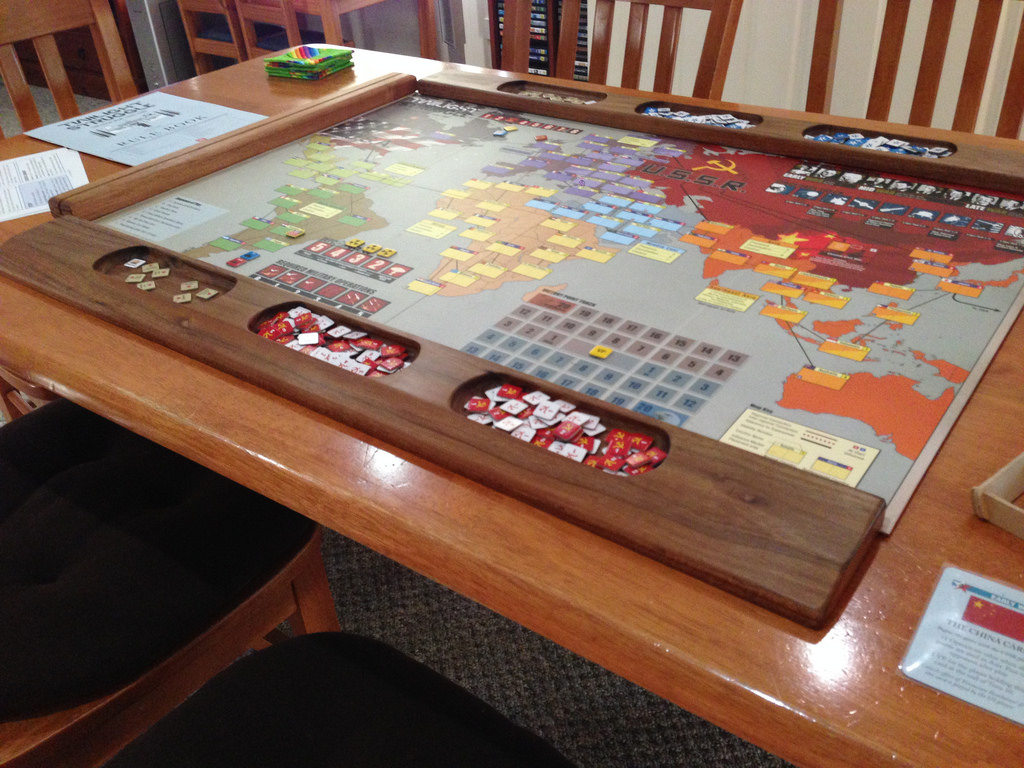
ts3
The holy grail of the board game community. This lovely photo was taken by David Gray and posted to Flickr. It’s licensed under CC BY NC 2.0. (Source)

Looking for more resources to help you on your board game design journey?
Here you go: no email required!

Like this writing style?
Check out my latest blog on marketing here.

For all the reasons above, I have played only the digital version available via Steam. The physical board game is gorgeous, but I’ve yet to find someone to play it with.

In Twilight Struggle, you play as either the USA or the USSR during the Cold War era from 1945 to 1989. This is strictly a two-player game. The objective is to score the most points by the end, be the first one to reach 20 points, or to run the DEFCON meter all the way up to DEFCON 1 (thermonuclear war) on your opponent’s turn. It’s played over 10 rounds, split into three eras with different cards: Early War, Mid-War, and Late War.

I won’t get too much into the DEFCON meter, since that’s a whole can of worms that’s outside of the scope of this breakdown. To score, you want to have control of certain regions of the board when scoring cards come around. Broadly speaking, if you have more countries in Africa, you get points when the Africa scoring card comes around. Other scoring regions include South America, Central America, North America, the Middle East, Southeast Asia, Asia, and Europe. Instead of both players racking up separate tallies, the score rather moves along a two-ended 20 point track (40 points total) with an advantage to the USSR or USA.
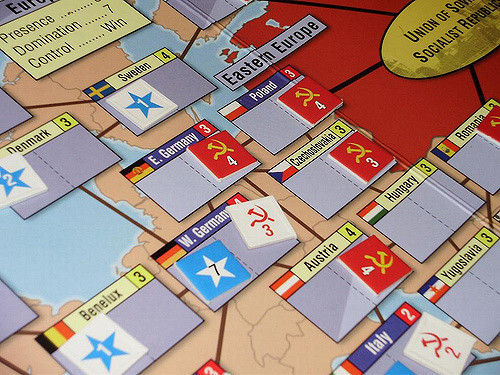
ts1
Back in the USSR. You don’t know how lucky you are. This lovely photo was taken by Nacho Facello and posted to Flickr. It’s licensed under CC BY SA 2.0. (Source)

A little confusing? Yep. That’s my beloved Twilight Struggle. In short: control countries and get points. I’m not going to get into how the cards help you to get points until the end. What I want to instead talk about is how Twilight Struggle masterfully maintains nail-biting, white-knuckle levels of tension throughout the game. That is the true brilliance of the game.

The theme immediately sets the tension.

It is incredibly terrifying to imagine the two world superpowers of the bygone century spending decades on end pointing massive world-crushing weapons at each other. Russian and American fingers lingering over a red button, ready to literally destroy the world. Twilight Struggle uses both historical references and gameplay mechanics to capture the feeling of fear and tension. In fact, it’s clear from the first read-through of the rules that a viable path to victory is to goad your opponent into mutually assured destruction. Yikes.

Both players have opposite strategies.

Without going into too much detail, conventional Twilight Struggle wisdom says the USSR tends to win the early game and the USA tends to win the late game. Imagine the paranoia that kind of asymmetry that causes. The USA is constantly on the brink of sheer chaos in the first five or six rounds, throwing buckets of water out of a sinking boat. The USSR, on the other hand, knows that they have to end the game quickly if they want a chance of winning at all.

You have to maintain a foothold in multiple regions because of the scoring mechanism.

There’s so many scoring cards in the game that you can’t pool your resources in one area and pray for the best. That’s a sure-fire way to lose. At the same time, there are some places that are basically hopeless to win, where you have to cut your losses and hassle the enemy like a fly.

The USA has a good grip on Central and South America, but the USSR has the better located Middle East on lock. Europe tends to split right down the middle. Africa and Asia tend to be toss-ups. Now with all this in mind, imagine the sweaty nerves the American player might get as Russia claims Algeria and Venezuela. Imagine the cold chill the Russian player might feel as America takes Iraq and North Korea.

There’s a lot going on at any given moment, and you can’t win all your battles. Plus, it’s not even clear which ones are worth winning.

You have to make sacrifices to succeed.

You will draw cards that work in your opponent’s favor. It’s inevitable. Playing one always feels bad. When you are forced to make a sacrifice, there’s an inner calculus where you say “at what time can I play this card to cause the least harm to me?” Then you have to ask “what should I do with the reward – mitigate the consequences or bolster a different strategy entirely?”


If you’re a designer, you owe it to yourself to play this game. It’s cheap on Steam. Give it a good five tries and expect to be terrible until you get your hours in. Study this game. It will teach you a lot about capturing the feeling of tension in your game.


Theme vs. Mechanics

Posted on 1 CommentPosted in Philosophy

“Theme-first or mechanics-first” might be the most asked “big question” in the board game community. It’s a bit of silly question. The false dichotomy we use to discuss these two elements, however, is really useful.

Looking for more resources to help you on your board game design journey?
Here you go: no email required!

Like this writing style?
Check out my latest blog on marketing here.

Theme and mechanics are inseparable parts of board games as a whole. When people talk about mechanics, they tend to mean to strategy, tactics, and rules. When people talk about theme, they tend to mean narrative, feelings, and the intangible aspects of a game. It’s a left brain / right brain mindset. The theme is how a game feels and the mechanics are why the game feels that way.

There is no hard-and-fast line that splits mechanics and theme. They’re two opposite ends of a continuing spectrum of detail.

Now that we’ve accepted that theme and mechanics are imaginary, abstract concepts, let’s put them to use. Start with feelings first, then think of ways that you can convey those feelings. It’s easiest to think of theme first – “it’s going to be a scifi, zero-sum game set in crapsack corporate dystopia.” Then you can get more specific about how to symbolically represent that theme – “the objective is to be the sole survivor by cutting your opponents down to size.” Then you can start developing mechanics. The further you go, the grittier rules become. Through playtesting, you can answer the question “do the mechanics suit the theme?”

Once you’ve got mechanics to suit a core theme, you can develop the theme a little more through art, story, and graphic design. At this point, you can start developing marketing around the theme. Game design starts with theme and ends with theme, but most of the time is spent in mechanics.

Theme and mechanics are interwoven at the fundamental level. They’re not concrete things, but rather viewpoints. Theme is what your game looks like from 10,000 feet up in the air and mechanics are what your game looks like under a microscope. Mechanics are atoms and the theme is an organism. Figure out the theme you want to capture, try building it through mechanics, then playtest and tweak until you successfully captured your desired theme.


Playtesting and Record Keeping

Posted on 5 CommentsPosted in Know-How

Game development is iterative. Making a great game requires soliciting and intelligently processing feedback. It seems easy enough from the outside. Write down what people say, update your game, and save a new copy. While that method will work, I’d argue it’s not ideal.

Looking for more resources to help you on your board game design journey?
Here you go: no email required!

Like this writing style?
Check out my latest blog on marketing here.

Our world is awash in an amazing amount of data, but we’re still pretty bad at processing it. When you playtest a game, alone or with other people, you’re going to be creating a lot of data. Who played? What was the outcome? Were there any problems that stopped the game in its tracks? And so on and so on…

How do you keep track of all this information?

There’s a lot of different ways, but first start by doing two things:

  1. Give each iteration of your game a version number. Every time you make a change that is not minor and superficial, up your game’s version number by one.
  2. Log every single playtest with the game and make sure your playtest matches with a game version number.
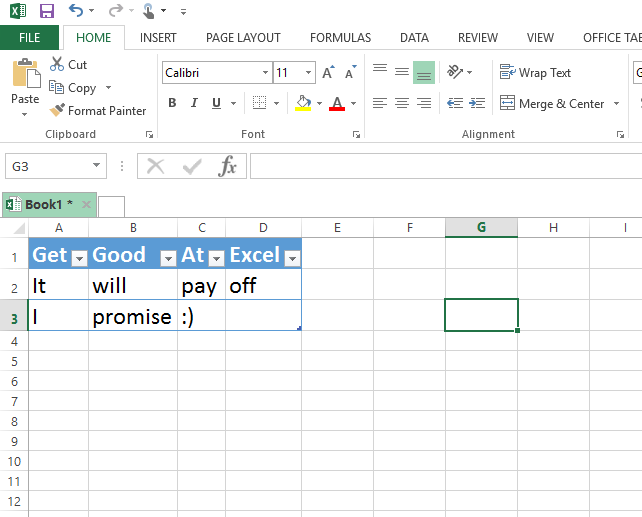
excel

Suggestion 1 is pretty straightforward, but suggestion 2 is a little more complex. First, I discourage the use of BoardGameGeek for playtest record keeping. I recommend that you use a spreadsheet. When logging your playtests, you want to capture all of the following information:

  • Who played?
  • How many people played?
  • Who won?
  • How long did the game take?
  • Describe each player’s strategy.
  • Were there any game-breaking flaws? If so, describe them.
  • Did you catch any minor errors? If so, describe them.
  • Were there any ambiguities in the rules? If so, describe them.
  • Did you catch any typos, graphic issues, or small errors? If so, describe them.

The last four items give you specific data to correct your game after playtesting. Take action on these as soon as you can and create a new version of the game. Then you can focus on information that you can extrapolate from the first five pieces of data.

Who played

Regular players are less likely to stumble on rules. Repeat players are better at helping you develop nuanced strategy. Newbies are better for sussing out communication issues and confusing parts.

Number of people played

Compare with game length and figure out how much gameplay time is affected by number of players. Combine with strategy to figure which strategy works best with each number of players.

Who won

Find the best strategy, ideally with the intention to create a game which has no “one perfect strategy.” Find out how much advantage repeat players have over new players.

Game length

This can help you find conditions under which the game ends prematurely or drags on.

Game strategy

This can help you identify which strategies work and which don’t.


The framework above gives you a lot of data to collect. How you use it is another matter entirely, and there’s no perfect answer to the question of “what’s the best way to use this data?” You’re going to have to make judgement calls and experiment over and over again until you make your perfect game.

It’s a lot easier to pursue perfection when you stay organized.