Carcassonne: Accommodating Different Play Styles

Posted on 3 CommentsPosted in Game Breakdown

At the geriatric age of seventeen years old, Carcassonne is one of the elder games of the recent board game renaissance. It remains one of the most enduring, nuanced board games on shelves today. It’s the kind of game even your grandmother can learn to play (and also beat you at).

Looking for more resources to help you on your board game design journey?
Here you go: no email required!

Like this writing style?
Check out my latest blog on marketing here.

As with any game, it’s an exercise in self-control to put both my thoughts into focused, prosaic form and to limit myself to highlighting just one good quality. I will therefore focus on one of the qualities that lends Carcassonne its status as a classic: the ability to accommodate different play styles.
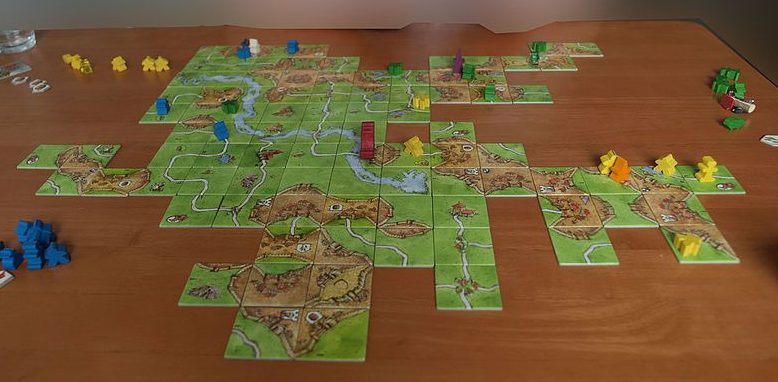
Photo Credit: JIP - CC BY-SA 4.0, https://commons.wikimedia.org/w/index.php?curid=49582392
Photo Credit: JIP – CC BY-SA 4.0, https://commons.wikimedia.org/w/index.php?curid=49582392

For those who have not played Carcassonne, here is a primer. Two to five players build the French village of Carcassonne, one tile at a time. The titles are randomized. Piece by piece, you define the features of the village: cities, roads, cloisters, and fields. Tiles must be built to where features are continuous – you can’t simply run a road into the city wall. (What’s wrong with you?!)

The objective of the game is to score the most victory points, which is done by placing meeples on features as they are being built. You score points for completed cities, road construction, and for surrounding cloisters in fields. You can also score fields, but that’s a little more nuanced, so I won’t get into that in this article. You don’t have many meeples to play, so you have to be judicious in their placement.
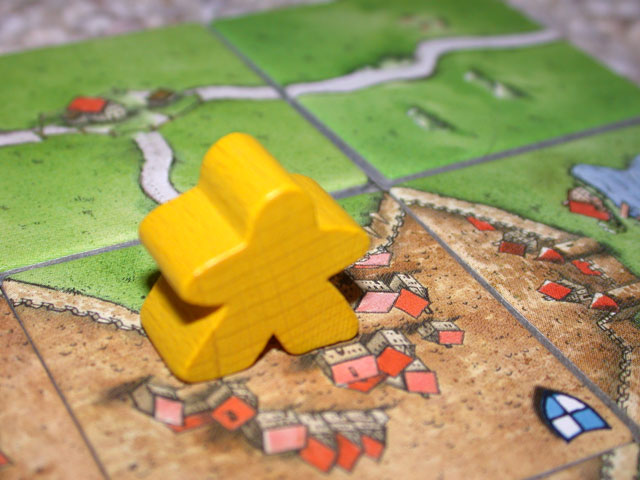
Photo credit: By Klo~enwiki at the English language Wikipedia, CC BY-SA 3.0, https://commons.wikimedia.org/w/index.php?curid=48620598

It’s a pleasant game. It’s pretty. It’s fun. It’s simple. It can be so nasty. It is this dichotomous nature that fascinates me so much with Carcassonne. You can base your strategy on two broad approaches: rising tides and zero-sum. The flexible nature of this game keeps it fresh, surprising, and exciting even as it approaches its twentieth birthday.

Let’s examine what these two approaches look like.

Rising Tides Carcassonne

It’s said that rising tides lift all boats. In Carcassonne, you can keep to yourself while you build long stretches of highway that net you ten or more points and megacities that net you twenty. You can create fields of greenery so vast that your farmers come back with wheelbarrows of points. You and your opponent(s) never have to conflict at all. You can all go your own way and the one who better manages their resources may well come out the victor.

Zero-Sum Carcassonne

Alternatively, you can fill your little French village with paranoia. You can trap farmers in tiny fields, leaving your opponents low on meeples for the whole game. You can curtail the growth of cities by placing tiles that close them off. You can put four-way stops in the middle of short stretches of highway. You can gridlock the countryside of France until nobody scores over thirty points. You can tease your opponents by cutting their opportunities down at every chance.
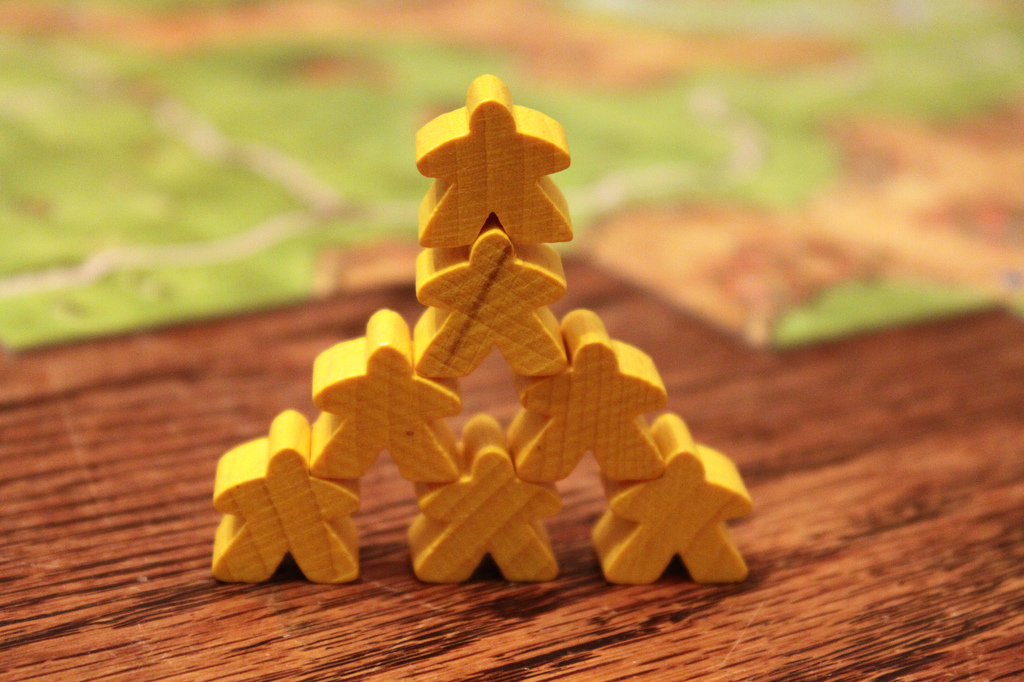

4269041592_ae083cd499_b

Even better? You can change approaches on a dime as it suits you. Is that not fascinating? So many games are so singular in their nature. There is no cutthroat version of Pandemic. There is no friendly game of Twilight Struggle (or War Co., for that matter). Yet Carcassonne can be both at once. If creating a game that can accommodate different play styles interests you, pick this game up. It’s about $20 on Amazon and you’re likely to be able to find it at a thrift store!


Should You Build for the Gateway Gamer or the Hardcore Gamer?

Posted on Leave a commentPosted in Philosophy

Much like theme vs. mechanics, separating people into gateway gamers and hardcore gamers is another persistent dichotomy in the board game community. Unlike theme and mechanics, though, I think this distinction is much more useful. The board game industry is growing at a rate of 29% according to ICv2, which is a clear indicator that the community is experiencing an influx of people who are just realizing how badass this recent board game renaissance has been. Welcome to the party!

Looking for more resources to help you on your board game design journey?
Here you go: no email required!

Like this writing style?
Check out my latest blog on marketing here.

Really quickly, let me clarify what I mean by “gateway gamer.” A gateway gamer, by my definition, is a recent board gamer who has a relatively small collection or who has just started playing the new classics like Ticket to Ride, Carcassonne, Patchwork, and so on. A hardcore gamer, on the other hand, has a larger collection or a taste for more heavyweight fare (hello, Twilight Struggle).

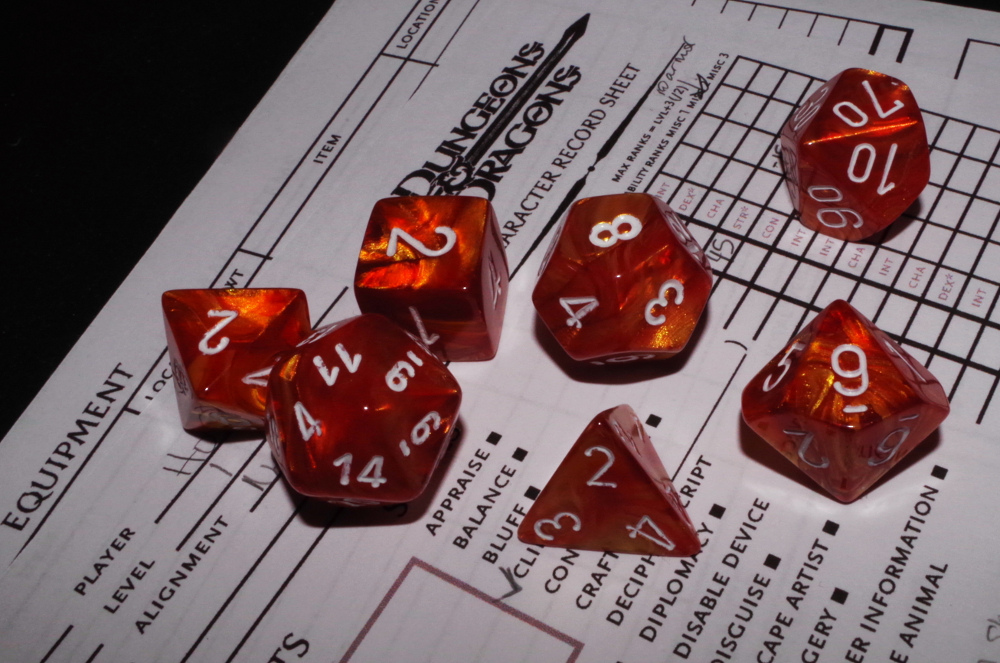
d20s
Ah, d20s: the calling card of the hardcore gamer.

Let’s imagine, for a moment, that you can’t serve both gateway gamers and hardcore gamers what they want at the same time. You would then have a trade-off. For gateway gamers, you’d prioritize a simple game based on straightforward concepts, understandable strategy, non-gamey language, approachable graphics, a short play time, and general ease-of-use. For hardcore gamers, you’d prioritize a complex game with nuanced strategy, baroque or extravagant art, uniqueness, a long play time, and replay-ability.

There is, to some degree, a middle road. You can make complex games based on simple mechanics like Patchwork. You can make a game’s art pretty and detailed while keeping the art approachable. You can make a game replay-able as well as easy-to-learn. You can make a game in the Goldilocks area of time – not too long and not too short. It’s just really tricky to walk this line. You need to say to yourself, “if I had to pick one side, which would I pick?” Commit to that choice and make it a priority, while catering to the other side as appropriate. As with so many things on my blog, the cadence remains the same: the choice is yours, just make an informed one.


Stay Strong through Endless Change

Posted on Leave a commentPosted in Motivation

Game development is extremely iterative by nature. Many game developers create dozens (or even hundreds) of versions of their game before it is finally complete. Simple games need to be played at least 100 times before they’re considered complete. For more complicated games, that number is closer to 1,000 or more.

Game development isn't a path from A to B. There's often a lot of detours.
Creative work isn’t a path from A to B. There’s often a lot of detours.

Looking for more resources to help you on your board game design journey?
Here you go: no email required!

Like this writing style?
Check out my latest blog on marketing here.

It’s easy, in the abstract, to shake your head to these numbers. “Sure, I can test my game 1,000 times.” It’s easy in the same way that running a marathon is – all you have to do is keep moving your feet for 26.2 miles. Don’t fool yourself. Staying motivated throughout the seemingly endless iterative stages of game development requires a lot of commitment and care.

It might seem like I’m dumping a cold bucket of water on your head when you need a warm blanket. Please understand: I’m trying to help you set realistic expectations. Bill Gates once said “most people overestimate what they can do in a year and underestimate what they can do in ten years.”

Endless change is a gift. Iterating your work until it is right is a gift. There is a meditative bliss in staying with an idea until it reaches the beautiful state you always wanted it to be in. You’d be amazed what you can do with hard work, time, and effort. You’d also be amazed just how much hard work, time, and effort it takes.

Practice begets mastery. Tenacity begets practice. After a while, baby steps start turning into leaps and bounds. Those baby steps are hard, purgatorial steps that feel like tiny eternities on ground that’s ready to give way. Push through it. Get stronger. Get better. The power to create what you want to create exists within you, but it is through persistence, patience, and iterative change that you will unlock it.