Dev Diary: 03/17/17

Posted on 2 CommentsPosted in Dev Diary

Pack a cooler, fill up the gas tank, and grab a 20 oz. styrofoam cup of coffee. We’re going on a road trip!

Looking for more resources to help you on your board game design journey?
Here you go: no email required!

Like this writing style?
Check out my latest blog on marketing here.

I’ve been hinting and hinting and hinting and hinting at a new board game project for a while. Today, I’m making it official!

I’ve just started development on a new board game. It’s called Highways & Byways. It’s a board game about college students dragging their beater cars across the nation in search of all places beautiful and forgotten. Every road referenced in the game will be a real place that you can actually go. You can read more about it here on the game’s website.
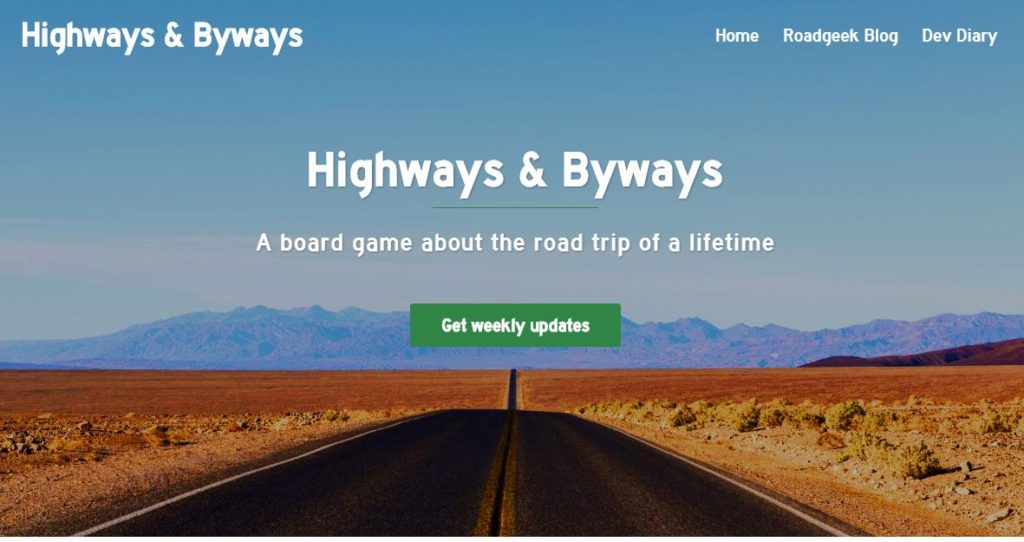
Highways and Byways website

I’m keeping gameplay-specific details close to my chest for now, but I want to make sure you know two things:

  1. I intend to fund this game on Kickstarter once I’ve completed most of the development…but I’m going to take my sweet time to make it great!
  2. I’ll be documenting my whole game development journey through a series of weekly updates. That’s the purpose of the Dev Diary.

I talk a lot about game development on this blog. That’s the blog’s raison d’être, after all. Yet as much as I’m proud of my high-level advice and cheerleading, I want to do more. I want you to see the specific challenges game devs encounter and conquer. I want you to learn from both my successes and mistakes. I want you to see the emotional highs and lows. I want you to see why I make games, so you know whether’s it’s right for you.


Now I’ll do what I’ll be doing most weeks: briefly covering the progress I’ve made over the course of the week. My progress has been focused on two primary objectives this week:

Objective 1: Set up a social media and blog system like I did for War Co.

Just this week, I’ve set up a Twitter, Instagram, Facebook page, and weekly blog for Highways & Byways. Whereas War Co. is all about sci-fi art and dry corporate dystopian humor, Highways & Byways will focus on gorgeous travel photos and wanderlust. The social media I’m running for Highways & Byways, like War Co., will not be used relentlessly to advertise, but rather to share things on the Internet that are really, really cool. As I find out what people like to see, I’ll tweak my approach while remaining within the theme.

Are you into travel? I have only a few days of content up, but you’ll like what I’ve got so far. Please follow on Twitter, Instagram, and Facebook.

In addition to the social media, I’ll also be running a weekly blog article on the Highways & Byways site that highlights a scenic road trip in the United States. These are real places you can really go to. I’m even including a map. If I’m going to spend all this time doing research to make a game that is both fun and accurate, I may as well share the fascinating things I’ve learned with you!

Objective 2: Continue mapping out the board.

Highways and Byways State Route 1
State Route 1 = Version 1 of the Game

With a robust social media and blog presence already set up and requiring minimal maintenance, I found myself free to do what I really wanted to do: develop the game itself! Highways & Byways is, from a physical perspective, a game based in geography. I’m essentially making a map of scenic roads. I started with a big map of the United States and I’ve started superimposing red lines in the shape of scenic roads. I have about 35 red lines on the map right now, but I’m aiming for 70.

Where do I find these scenic roads? I use a variety of resources, including the Federal Highway Administration website, My Scenic Drives, my own memories of thousand-mile drives, and Google searching when all else fails. Some states are really easy to find scenic roads. Some are excruciatingly difficult – I’m looking at you, Texas. I have a pretty complex vision of what I want the board to look like, but it’s going to take a lot of research and work to get there. I’m putting my head down and working, for I have this detailed vision that I find too difficult to articulate. I have to speak through my actions.

Once I complete a map of byways, I’ll connect them with highways. Then I’ll start self-testing to see how long it takes me to cross the map. This early data will give me a sense of how the game needs to be structured and at what levels its objectives need to be set in order to be balanced.


It’s going to be a long journey, my friends, but I’m glad you’ve come along for the ride.


Colony: Letting Leaders Lead without Losing Losers (A guest post by Burt Yaroch of the Healthy Gaming Network)

Posted on 1 CommentPosted in Game Breakdown

Brandon:

The following is the second guest post by Burt Yaroch of the Healthy Gaming Network. Not only does he help gamers make healthier choices, but he’s a fledgling designer himself! Today he shares with us a game he really enjoys: Colony.

Burt:

I’ve fallen in love with Colony by Bezier Games, designed by Ted Alspach, Toryo Hojo, and N2 (the pen name for Yoshihisa Nakatsu). The engine building, the upgrading, the variable game construction, and even the insert are all fantastic!  My wife asked me the other day if we could play it again and that NEVER happens in our household. My love of this game is what makes me forgive Colony for what I see as a major design flaw.

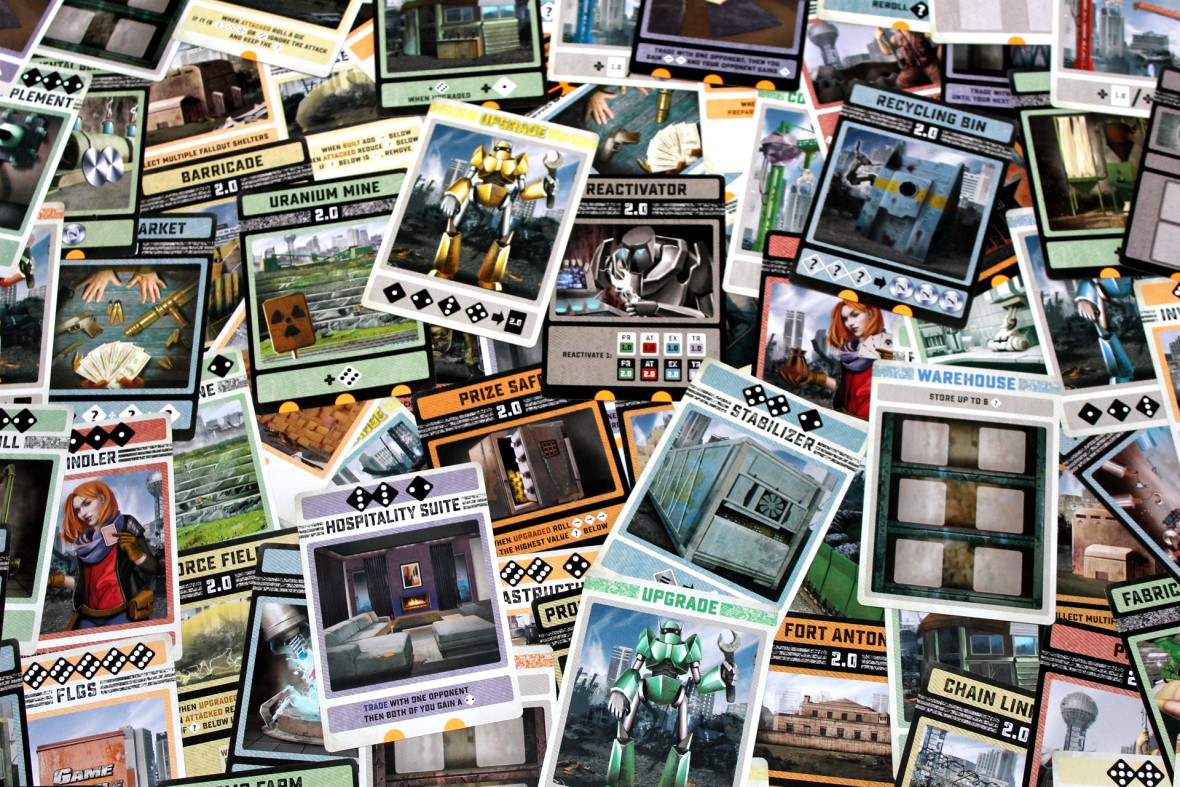
Colony Cards on Table, by Eric Yurko
Photo by Eric Yurko of “What’s Eric Playing?” (CC BY-NC-SA 4.0)

I believe this game suffers from one terrible flaw, which is ironically designed to reign in its “runaway leader” tendencies. What I have found in my plays of Colony and my research for this article is that this style of gameplay is unfairly criticized, and Bezier Games – understandably – attempts to compensate for this. I mostly like the way Colony handles this – with just one major exception! In this breakdown, we’ll delve deep into the enigmatic balance of leaders running away and losers catching up.

Looking for more resources to help you on your board game design journey?
Here you go: no email required!

Like this writing style?
Check out my latest blog on marketing here.

What’s a runaway leader? Are runaway leaders always bad?

Let’s define some terms first. I’m going to use the term “runaway leader” to refer to a specific, purposefully included design mechanic. It is a mechanic by which the player in the lead position gains advantages that serve to move them further into the lead. To borrow from the vernacular of control theory, you create a positive feedback loop. The more you have, the more you get. The positive feedback loop snowballs until the winner is crowned. Colony has a “runaway leader” mechanic, but it reigns this in with different mechanics that act as counterbalances.

Carefully implementing a “runaway leader” mechanism provides players with a reason to get the points and resources early on for the promise of future advantages. Brandon has previously pointed out in his discussion of Monopoly, that too much of a “runaway leader” can be terrible. Too little, however, takes the steam out of the game. It gives you no incentive to do well early on. “Runaway leader” mechanics aren’t inherently good or bad – they are a design choice based on how designers want their game to play out.

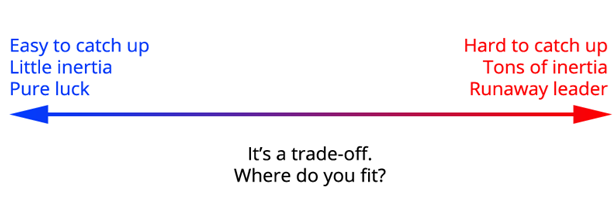
A graph showing the trade-off of luck and skill in games
Brandon: I added this graph. “Runaway leader” is used as an epithet for unbalanced games, but perhaps it’s an insult hurled at highly meritocratic games. Think beyond the words themselves.

Colony uses runaway leaders wisely…

Was Colony designed with a runaway leader mechanism? Absolutely. Players simultaneously build resource generators and victory points, the latter directly leading to a win. Having more resources leads to the ability to purchase additional resources more quickly which in turn leads to the faster acquisition of victory points. The person in the lead usually has the advantage (even though VPs may also be obtained without direct resource gain).

The designers of Colony likely asked themselves, “Is this runaway leader mechanism a bad thing?” I say “no” for two reasons.

One, the game is advertised at playing out in 45-60 minutes. If I fall behind and into a pit of despair, I only have to languish for a short time before my misery comes to an end. It’s hard for short games such as Colony to have a runaway leader “problem”, even if mechanics promote runaway leadership.

Board games must let leaders lead. To do otherwise is to patronize lesser players with participation trophies.

…and Colony handles runaway leaders with elegant “Catch the Leader” tools, for the most part…

The first “Catch the Leader” tool is Trade. It allows players to gang up on the leader.  Trading in Colony offers a greater advantage than in a game like Catan, as here both participants can be rewarded with resources simply for the act of trading.  Keeping the leader out of any trade deals will allow other players to close the VP gap and slow the runaway.

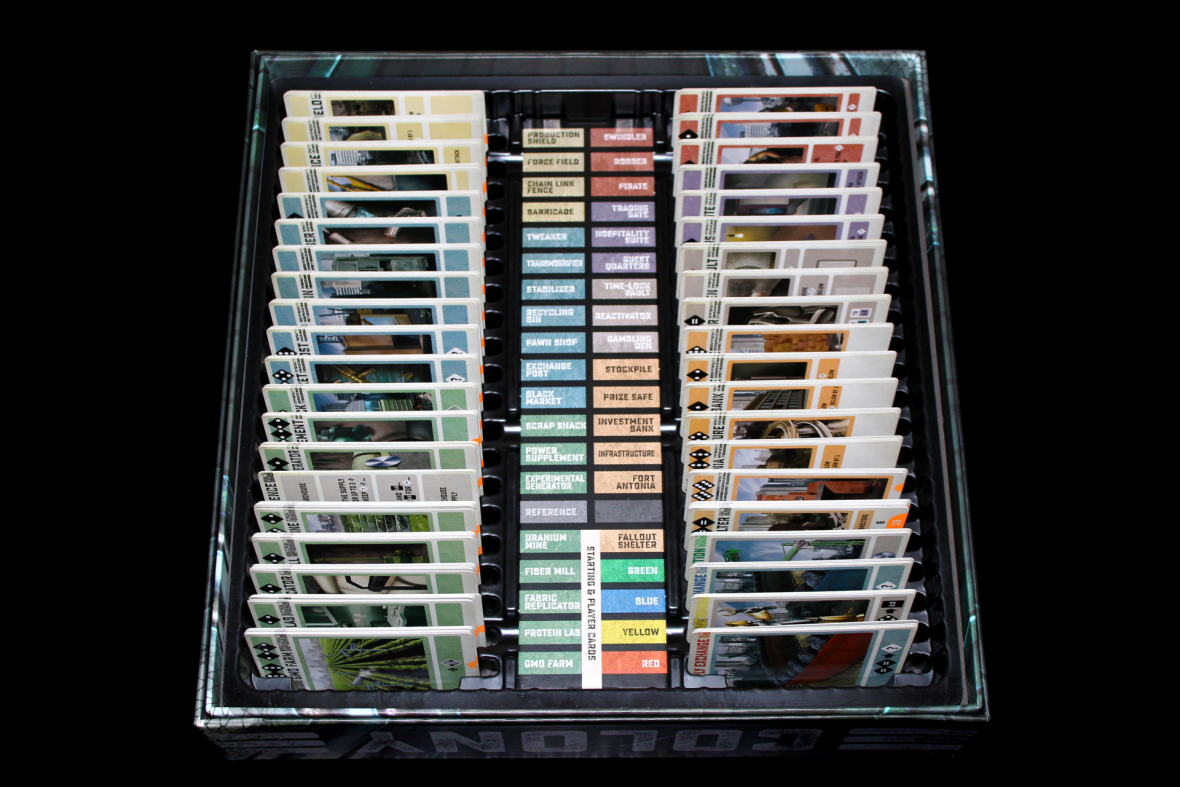
Colony Cards in their case, photo by Eric Yurko
Photo by Eric Yurko of “What’s Eric Playing?” (CC BY-NC-SA 4.0)

The second way players can selectively target the leader is through stealing resources.  This not only limits the leader’s VP advantage, but also forces them to commit resources to mitigating theft, further chipping away at the leader’s lead.

The synergy of these mechanics make for smooth, fast, and fun gameplay where the runaway leader mechanic is not even detrimental in 3-4 player games, and only slightly so in 2 player games. In the dozen or so games I have played, most of the games were very close and none had players complaining about runaway leader or even considering it.

…But then Colony spoils their wise use of “runaway leaders” with a single, inelegant “Catch the Leader” mechanism that overcompensates

This begs the question of why Colony, with two Catch the Leader mechanics already implemented, includes the following rule: “Player(s) may discard one of his cards in return for a number of resources equal to the difference between his score and the leaders score.” Think about it. However far behind the leader I am, I can discard a card (which usually at this point in the game is irrelevant to me) and trade it for all-important resources IN EQUAL NUMBER to the distance I am behind the leader on the scoreboard!  We intentionally play-tested this a few times just to see what would happen. It almost always turned a blowout game into a nail biter…and some into come-from-behind wins.

If the designers were concerned about runaway leaders, an obvious solution would have been to decouple resources from the VPs. Alternatively, they could have added further catch-up mechanics which fit into the theme and pacing of the game. For example, the Headwind mechanic from Dominion, a game which Colony resembles. This variable would slow down the leader’s progression as gaining VPs make future plays less efficient for the player.

Instead, the designers of Colony created an inelegant, unnecessary, and game-breaking rule that could be slapped onto any game’s ruleset to provide a Hail Mary pass. That is, if a Hail Mary counted as eight touchdowns instead of just one. If you play by this rule, all the gameplay comes down to a coin toss on the last turn – anathema to casual and hardcore gamers alike. I colored over both references to this rule in my rulebook with a black Sharpie. Out of sight, out of mind. Fortunately for all of us, games of Colony are usually so close that I can rarely see this being employed even by gamers who didn’t smite it from existence.

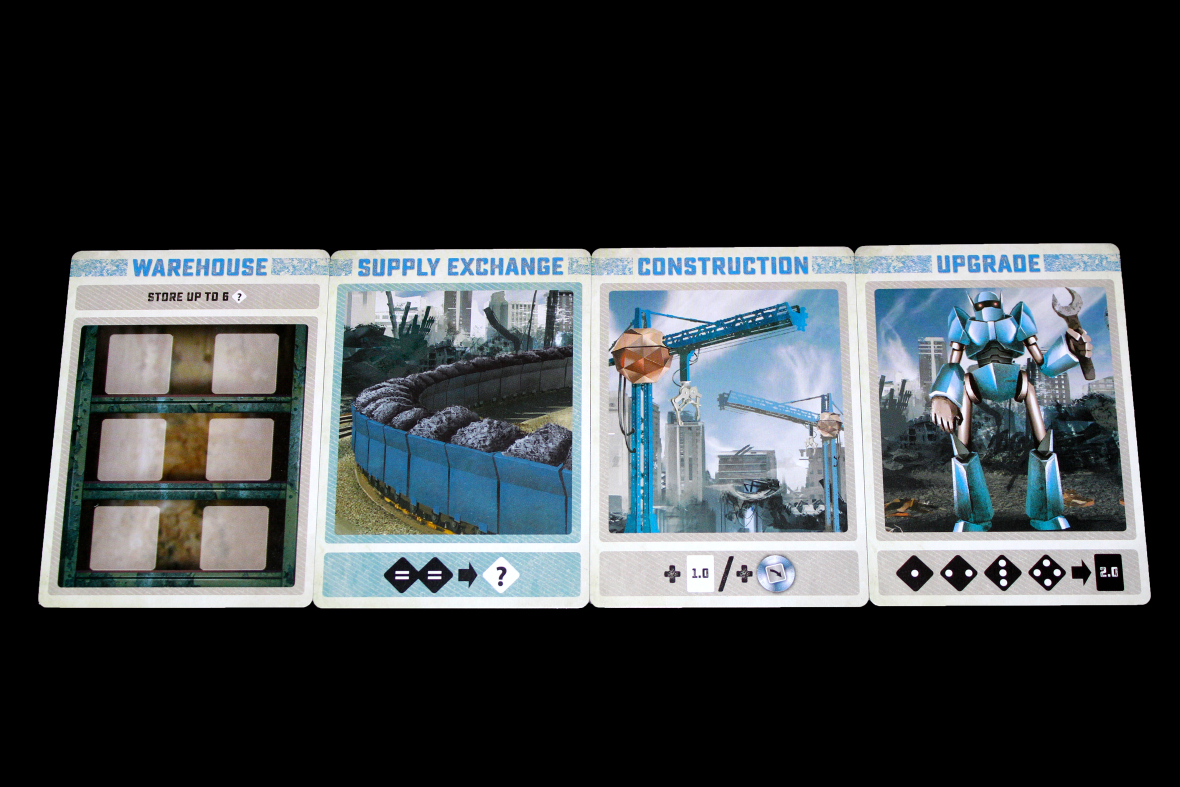
Colony Cards lined up on table, taken by Eric Yurko
Photo by Eric Yurko of “What’s Eric Playing?” (CC BY-NC-SA 4.0)

Parting Words: How to Let Leaders Lead without Losing Losers

If you want to make wise use of a runaway leader mechanic, here are my recommendations:

  1. If your game is under 60 minutes, don’t worry unless it’s really obvious. Gamers can handle a fleeting blow to their self-esteem.
  2. If you want leaders to be able to run ahead, you have to keep your game short – preferably under 60 minutes. When players feel like they can’t catch up, that is a great time to declare the victor.
  3. Remember the runaway leader mechanic is in the game because you put it there. Don’t like it? Nix it.

If the runaway leader mechanic is an accident, you have a choice to make. If you keep it in the game, you’ve got to mitigate with negative feedback (making each subsequent point on the board more difficult to reach). You still have to respect the effort of all players in the game.


Why does accessibility in board games matter? (A Guest Post by Michael Heron of Meeple Like Us)

Posted on 2 CommentsPosted in Philosophy

Brandon: The following article is a philosophical guest post by Michael Heron. He’s the professorial mind behind Meeple Like Us, a board game review site with an academic focus on accessibility. His site is a good read, you should check it out!

Looking for more resources to help you on your board game design journey?
Here you go: no email required!

Like this writing style?
Check out my latest blog on marketing here.


Michael:

Why, hello there. I didn’t see you come in. You caught me quite by surprise. Let me switch off my carefully intellectual classical music. I’ll just put down this dubiously large book of impressive philosophy that I was totally reading and not holding like a prop. What do you mean it’s upside down? Oh dear, what must you think of me? I clearly fumbled its orientation in my shock at unexpected guests.

Photo taken by Jón Sigurðsson and posted to Flickr under the CC BY 2.0 license (Source).

My name is Michael Heron. For the past year or so, I have been running Meeple Like Us. We’re a board game review blog. I know, I know – in gaming circles that’s like being a Hollywood barista working on a screenplay. Everyone is doing that – everyone fancies themselves a critic. What makes us different is that we dig pretty deeply into the accessibility of tabletop gaming experiences. Meeple Like us is part personal obsession and part research project. In real life, I’m a lecturer at Robert Gordon University in Aberdeen, with a particular interest in the accessibility of games. Meeple Like Us is a series of ongoing notations regarding my work on that topic. For a blog I expected to be read by a handful of academics a couple of times MAYBE, it’s been surprisingly successful.  That has been personally gratifying of course – as an academic I’m used to the readership of my papers being counted on the fingers of a single head.  However, I think it’s also promising evidence that there is an appetite out there for this content – a desire to view and evaluate gaming through the lens of impairment and exclusion.

That’s a conclusion that should matter to any budding game designer, because it suggests what I believe to be a huge opportunity for the whole sector. Looking at the United Kingdom, the statistics are telling. Around 19% of the working population have some kind of identified impairment. Around one child in twenty is affected. There are five million pensioners with a disability. Two million people have sight problems. Scale those figures up or down for your own national context, and they tell you one thing – there are a lot of people out there with an impairment, or two, or more. That by itself might be merely interesting, but the thing that matters to you is that many of them want to play your games. It’s a massive market, and right now it’s not being well served. It’s a market that by and large doesn’t know yet they want to play your games because many of them believe gaming isn’t for them. That’s a perspective we can change. It’s certainly a perspective over which you as a designer have a great deal of power.

Many games won’t be accessible to everyone. That’s inevitable and to attempt to achieve genuine parity would create a prohibition around whole genres of games. Dexterity games will never be ideally accessible for those with physical impairments. Pattern matching games disadvantage those with diminished sight. Bluffing games require emotional confidence. Games with time constraints are an intersectional accessibility concern.

It’s important with accessibility that we understand how powerful small changes can be – we need not solve every problem in order to make a real difference. Disabilities exist on a nuanced spectrum – small changes here and there can open up audiences you didn’t even realize were available. The difference between using a 12pt font and a 14pt font can be “playable” and “unplayable.” Your choice of color might be the difference between someone being able to enjoy your game and colorblindness preventing them. Do you have a board? Do you include grid references? If not, you might be stopping someone from verbally expressing instructions in a clear and convenient way. There are lots of easy accessibility wins available. On Meeple Like Us, you’ll see many case studies of games where we discuss how the subtle interrelationship between components and mechanics can unintentionally exclude players. We would never advocate that you sacrifice core design principles in order to achieve universal accessibility. Some games, unfortunately, will never be accessible to certain groups of people. What we hope is that there is a great enough variety of accessible games, in all categories, that everyone can find something great to play with the people around them. A game need only be accessible for one group of players to contribute to that.

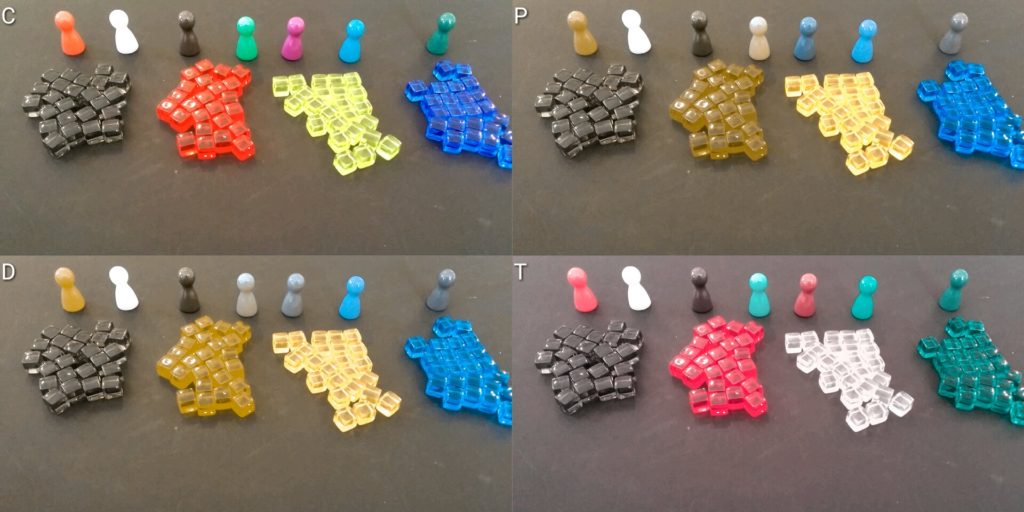
Brandon: Different forms of color-blindness can affect how you experience Pandemic. (Photo from Meeple Like Us).

To that end we’re working on a set of comprehensive Tabletop Accessibility Guidelines – a document that will provide hints and suggestions for making accessible games. We don’t have it yet, because Meeple Like Us is a side project that must co-exist beside a demanding full-time job. It’s coming, though.

However, more important than a list of suggestions is for designers to adopt a wider perspective on who their audience may be, and the challenges they may face in playing their games. Accessibility guidelines are great, but accessible thinking is so much better. At its best, accessible design shapes a project from its beginning. Finding ways to make tasks easier to do, or information less costly to process, is always going to be easier when it’s not constrained by accumulated design. Designers that adopt accessible thinking will find it influencing every decision made, from concept to completion.

One of the things I’ve found over the past year is that there is a phenomenal amount of variety in tabletop accessibility. Tiny changes in game design may have remarkable impact on how playable the game might be. Accessibility guidelines won’t ever substitute for a deeper understanding of how people interact with the games you create. With Meeple Like Us, we’re building up a growing library of case studies that permit consumers to make informed choices, and game designers to see how tightly coupled their decisions are to the playability of their products. Our blog is a library – designers can pick a game that is similar in mechanics to their own, and see what issues we discussed. Simply knowing what problems other games have exhibited will illuminate parts of a design that may not have been at all obvious.

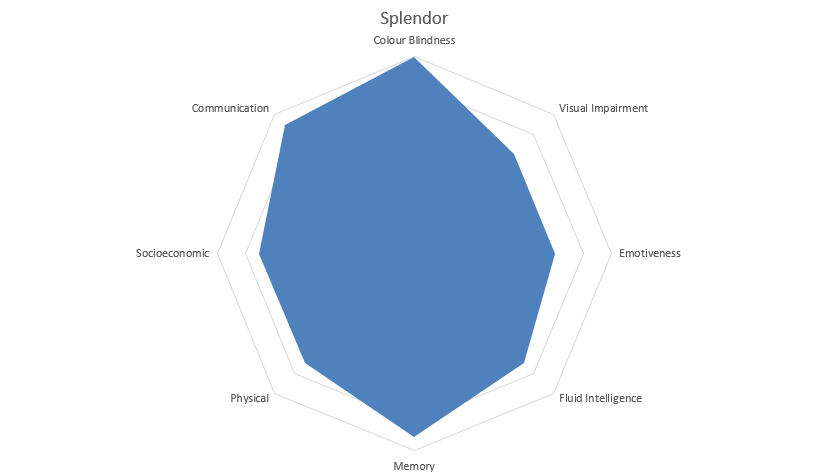
Meeple Like Us Radar - Splendor
Brandon: One way Meeple Like Us assesses the multiple dimensions of accessibility is with charts like this. This is the accessibility chart for Splendor, which did pretty well in most areas.

The good news is that most of the difficult work here is done for free once a designer decides to consider accessibility in a game. Most of the problems I see in the games we discus are not malicious. Nobody sets out to design an inaccessible game. I wouldn’t say the problems are due to indifference. The discussions I have had with game designers have been extremely positive once they realized the intention of the work. It’s not even that most designers are thoughtless – it’s that most designers haven’t realized there is anything of which they must be thoughtful.

If you are interested in developing an accessible game, you’ve cleared the first hurdle. Your own experience and empathy will help guide you towards more accessible thinking from that point on. You undoubtedly have friends with accessibility concerns. You may have older relatives with sight or memory problems. You might have nieces or nephews with a learning condition. Wouldn’t it be great if you could play your favorite games with them? Think of how valuable it would be if they could play your favorite games with you. We play games for many reasons – fun, critique, and competition. Mostly though we play them to make connections with the people around us. Whenever someone is excluded from play because of inaccessibilities, those connections are lessened.

It’s important that we understand when people are making comments about accessibility – they will almost never take that form. When someone says “the components are too fiddly,” they are making an actionable observation about your game. If they say there’s too much to remember, are there ways you can make the information challenge less intense? It’s easy to simply think, “Oh well – this clearly isn’t my audience.” The truth of the matter is that they could be if you acted upon what they tell you. Those friends and family are an information goldmine if you just dig it out of them.

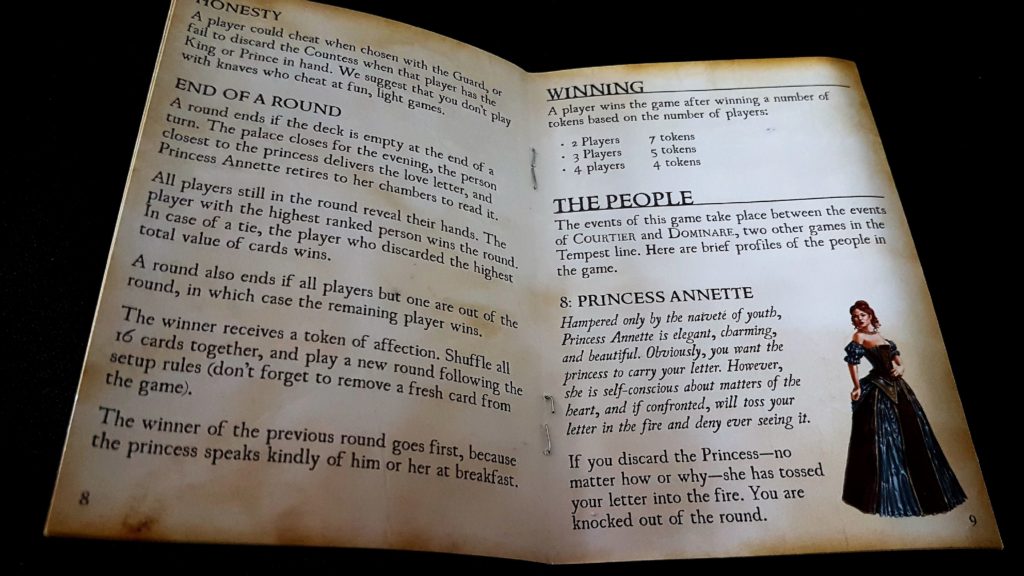
Love Letter Ruleset
Brandon: There are many areas to consider when making accessible games, including components, gameplay, and rules.

Let’s not think though of accessibility purely in terms of impairment. Let’s think of it in terms of simple user design. There is little difference between an extraordinary person in ordinary circumstances, and an ordinary person in extraordinary circumstances. We are all impaired, at some point in our lives. Perhaps it’s a permanent impairment, such as the loss of a limb. Perhaps it’s a temporary impairment such as a broken arm. Perhaps it’s a situational impairment, such as holding an infant. We all benefit from accessibility in those circumstances. Accessible games are better for everyone, even if the benefit tends to be experienced more intensely by gamers with disabilities.

Finally, let us not forget the role that selfishness plays in the drive for accessibility. You may yourself feel the sting of age robbing you of the spring in your step and the dexterity of your fingers. The aging process is not kind – it usually takes more than it gives. Loss of physical precision and sight becomes increasingly common the older we get. Our cognitive processes change. Our hearing may degrade. When I’m older and retired – assuming such an institution still exists by then – I want to fill my days playing those games for which my real life obligations never permitted me time.  I will only be able to do that if they’re designed with accessibility in mind. When we design for players with impairments, we design for our future selves. Let’s be selfish here – let’s promise Future Us that they’ll be able to enjoy the games that we create.