Your to-do list is ever-growing. You need to play-test your game a few hundred times, commission some art, start a Twitter account, keep your blog up to date, fix that broken mechanic, tweak some minute detail you’re afraid you’ll forget about, all while holding down a 9-5 (or 6 or 7) job and raising kids and paying the bills…
Let’s face it. Sometimes board game development isn’t fun. Sometimes you don’t have time or energy to do what you’re trying to do. Relaxation and recreation can take a back seat to productivity.
Yet that’s self-sabotage because board game development is an intrinsically creative endeavor. Tapping into your innermost creative depths is very hard to do if you don’t meet basic needs first – the easiest of which to ignore or overlook being the need for mental rest.
Game development is hard work. Yet it’s important to take some time to remember why you decided to start in the first place. If you’re a developer, you love games – I’d be willing to take a money wager on that truth if you stay at it for more than three months. Don’t forget why you fell in love with games!
Can you feel the love?
The easiest way to blow off some steam when you’re exhausted from creation is to play some games. Don’t overanalyze them, don’t study them, just play them. Play them badly if you’re too tired to play them competitively.
There may be some days when you can’t play games, or even stand to look at any piece of cardboard with a victory point track printed on it. Go hang out with your friends. Call your loved ones. Exercise. Go outside. Drive 1,000 miles for no reason and with no destination. Do something you always wanted to do. It’s okay. Your game will still be there.
Game development is a marathon, not a sprint. You must work hard and be consistent. Keep showing up and trying week after week. Just make sure you’re running at a sustainable pace.
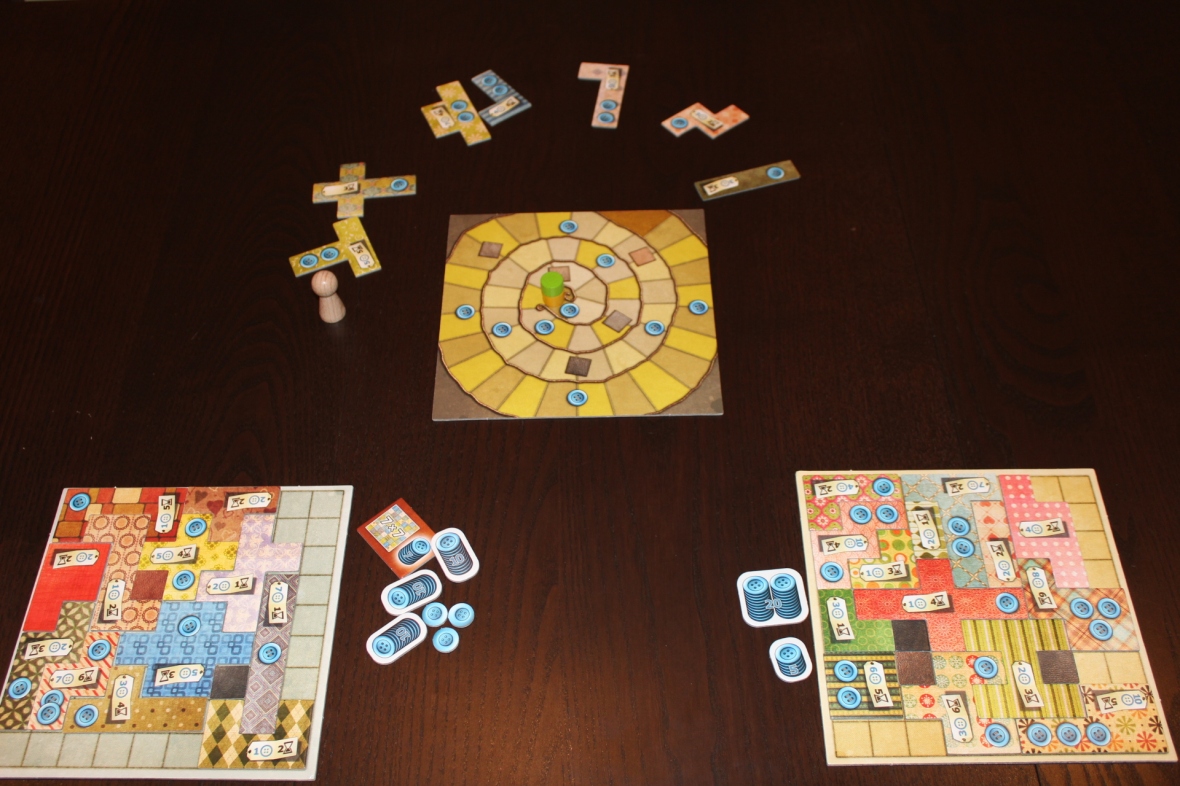
For the inaugural post in my series of Game Breakdowns, I want to talk about the perineal /r/boardgames choice for “2p game to play with my girlfriend.” I’m speaking, of course, about Uwe Rosenberg’s Patchwork. It’s the perfect game to share with someone who only has a tangential interest in board games, or a “gateway gamer”.
Photo by Eric Yurko of “What’s Eric Playing?” (CC BY-NC-SA 4.0)
There’s a lot of reasons this game tops charts as being the favorite to share with a “non-gamer”. It’s easy-to-learn and visually approachable. Patchwork also has a high thread-count of strategy sewn deep into its fabric. I am going to point out specific examples of things I like about Patchwork and use them to explain why I think it works so well as a gateway game.
First, a little bit about the game. It is a 2-player game that takes about 30 minutes once you know what you’re doing. The objective is to score the most points, which you do by collecting buttons. Each button is worth a point. You can use buttons to buy differently shaped pieces to cover up your board. You want to cover up as much of you board as possible since 2 points are deducted at the end of the game for each square you don’t fill. It’s actually pretty common to score negative in this game.
You intuitively understand a viable winning strategy in Patchwork.
Photo by Eric Yurko of “What’s Eric Playing?” (CC BY-NC-SA 4.0)
The objective of Patchwork is to score the most points, but that’s kind of an abstract concept. When you see the game in action for the first time, you very viscerally understand that filling up your board is critical to a winning strategy. You start buying pieces and arranging them like a very slow game of Tetris.
Perhaps you don’t even pay attention to collecting buttons until the end. Point is, even a non-gamer can play Patchwork for the first time and feel like they are accomplishing something. That’s such an important feeling for a gateway game. Many games are very unforgiving until the third or fourth try.
It’s pretty and most people have never seen anything like it.
Photo by Eric Yurko of “What’s Eric Playing?” (CC BY-NC-SA 4.0)
It’s hard to look at Patchwork and not find it charming. It’s a cute-looking game. Gateway games don’t have to be cute, but being bright, unique, and crystal clear helps a lot. There are board games that look like Excel spreadsheets, and that scares people away – as unfair as that might be to an otherwise well-designed game.
It’s short.
Gateway games don’t have to be short, but non-gamers, in my experience, tend to get fidgety after more than an hour of gameplay. Patchwork takes only about 30 minutes, so a non-gamer can dip their toe in the board game waters without committing a bunch of time.
It has depth on repeated plays, but the depth comes from simple mechanics.
Here’s the truly beautiful thing about Patchwork: it’s got hooks. Nuances start to reveal themselves in intuitive, but nonetheless complex and impressive ways, upon repeated plays. The “button income” gives you an impetus to choose certain pieces instead of others, even if they’re harder to fit on your board. There’s a trade-off between buying a piece and holding onto your buttons. You can even screw with your opponent and turn it into a savage take-that game by taking the piece they want to buy OR by accelerating the pace of the game.
You might need that cross piece, but if your opponent needs that three-button piece more than you need the cross, you can totally screw them over. #SavagePatchwork. Photo by Eric Yurko of “What’s Eric Playing?” (CC BY-NC-SA 4.0)
The mechanics may be simple, but the relationships between them give the game life and longevity. It’s not Twilight Struggle. You don’t need an encyclopedic knowledge of the game’s minutae to hustle at it. You just need clever wits and a couple of run-throughs. Gateway gamers appreciate that.
Does anybody want to play Patchwork with me? It’s $20 on Amazon, if you’re interested.
Want to see where these gorgeous photos came from? Check out What’s Eric Playing?, a fantastic site run by Eric Yurko.
Gaming is a mysterious hobby, isn’t it? In a world of so many opportunities (and distractions), what draws us to the gaming table week after week? To tell you the truth, I don’t really know! I have, however, gazed at my navel for long enough to come up with some fun theories.
It’s become a cliché to talk about the widespread proliferation of telecommunications and how it’s simultaneously brought society closer and driven a wedge between us and our neighbors. In a world where video games have been around for well over thirty years and virtual reality is very close to becoming actual, affordable reality, the revival of the board game industry seems to have come out of nowhere. Perhaps board games are popular because they’re one of the last vestiges of uninterrupted meatspace socialization. Board games inhabit a world where endless texting is the worst faux pas. In-person, dedicated social interaction is powerful enough to thrust an industry once marred by endless Monopoly clones into a renaissance until it emerges as a billion-plus dollar juggernaut.
The game is pretty close, but his habit of texting under the table might result in a loss.
They’re Meritocratic
Life is unfair. Sometimes it’s cripplingly, depressingly unfair. A well-designed game that’s built to last, however, isn’t. In fact, the idea of making a game that’s more than a little unfair gets relegated into one of three categories: “push-your-luck”*, “unbalanced”, or “outright broken”. You take out all the “unfair” games, and what’s left over is a slew of games where “if my strategy is clever and I stay focused and work hard, by gosh, I’m certain to win, or at least get close!” Isn’t that immensely satisfying?
*I’ll admit this genre of games has its charms, but I can’t think of any PYL games that I want to play after five games.
A Game is a Microcosm of Life
This is my favorite theory on why games are enjoyable. From birth on, we as humans are programmed to identify objectives and conquer the obstacles that get in our way. Our ancestors ran five miles to capture their food. Today we strive for more abstract goals like a better career or a better relationship. These are laudable goals, but perhaps we crave the unambiguity of primal goals – the life or death goals. Games let us chase concrete goals with clear obstacles, rules, and conditions in a risk-free environment. In a way, they let us live miniature lives in the same way that books or movies do.
By playing a board game, maybe you become the pieces.