Reality and Narrative

Posted on Leave a commentPosted in Motivation

Creativity is painful. It’s hard to make something worthwhile, to put your name on a product, to cast your work out into the world for judgment by people who don’t care nearly as much as you. When your heart is wrapped up so tightly in what you do, the smallest criticism can feel like a kick in the chest.

Looking for more resources to help you on your board game design journey?
Here you go: no email required!

Like this writing style?
Check out my latest blog on marketing here.

That’s Narrative screwing with you.

Broadly speaking, our experience of the world is a mix of what actually happens to us (Reality) and how we react to it (Narrative). As a metaphor, consider someone who is out of shape who starts running for the first time. During the 11 or 12 minutes in which she begins to run that first mile, she’ll feel a lot of pain – a burning in her chest as lungs struggle for oxygen, legs aching from muscles not often used. The pain is screaming “you’re hurting yourself, you’re hurting yourself!” That pain is Narrative. However, the Reality is that she’s bettering herself. For her to continue, she must realize that the Narrative and Reality aren’t matching up. If she wishes to succeed, she must react to Reality, not Narrative.

Before my second Kickstarter for War Co., I sent out copies of the game to over a dozen reviewers. Eight of them reviewed the game in time for the campaign, and seven were positive. In Reality, War Co. was at least enough of a crowd-pleaser to succeed at crowdfunding. Yet my Narrative was pre-occupied with the one mixed review. Yeah, it wasn’t even a negative review, just a mixed one. That’s absurd, isn’t it? From an objective standpoint, my Narrative was absurd, but I was reacting to it until I sat down and talked myself back to Reality.

You’ll probably start out naive and get your butt handed to you. It’s a rite of passage. You’ll eventually work your way up to where your Reality is far better than the Narrative you tell yourself. Once you reach a certain point in your creative projects, the biggest problem is quite likely to be your own inner demons – your Narrative gone awry.



Love Letter: Elegantly Balancing a Game

Posted on 1 CommentPosted in Game Breakdown

As both a lightweight game and an accurate portrayal of the courtship process, Love Letter is an exemplary work. I often feel that “filler games” aren’t subjected to the same level of analysis and thought that many heavier games like Twilight Struggle or even Pandemic are. That’s a missed opportunity if I ever saw one! Love Letter is the kind of game that you can play while waiting for stragglers to show up at your game night or to give your uninitiated family a taste of board game culture. It’s the sort of game you can get your arms around in five minutes and understand the deeper elements of in twenty.

img_4930

Looking for more resources to help you on your board game design journey?
Here you go: no email required!

Like this writing style?
Check out my latest blog on marketing here.

Love Letter is really simple at heart – win the game by winning the most rounds, win the rounds by having the card with the highest value in your hand at the end of the round OR by eliminating everyone else. Everybody holds one card in their hand. When it’s your turn, you draw a second card. You choose which card to keep and which card to play. Each card has a unique effect and there are eight types of cards.

Though it’s super easy to pick up, the game turns into a slightly heady mix of deduction, risk mitigation, and probabilistic thinking. All the strategy fundamentally comes down to a single principle of game design that became apparent to me after a few rounds.

The eight types of cards are elegantly balanced by short-term vs. long-term value.

img_4931

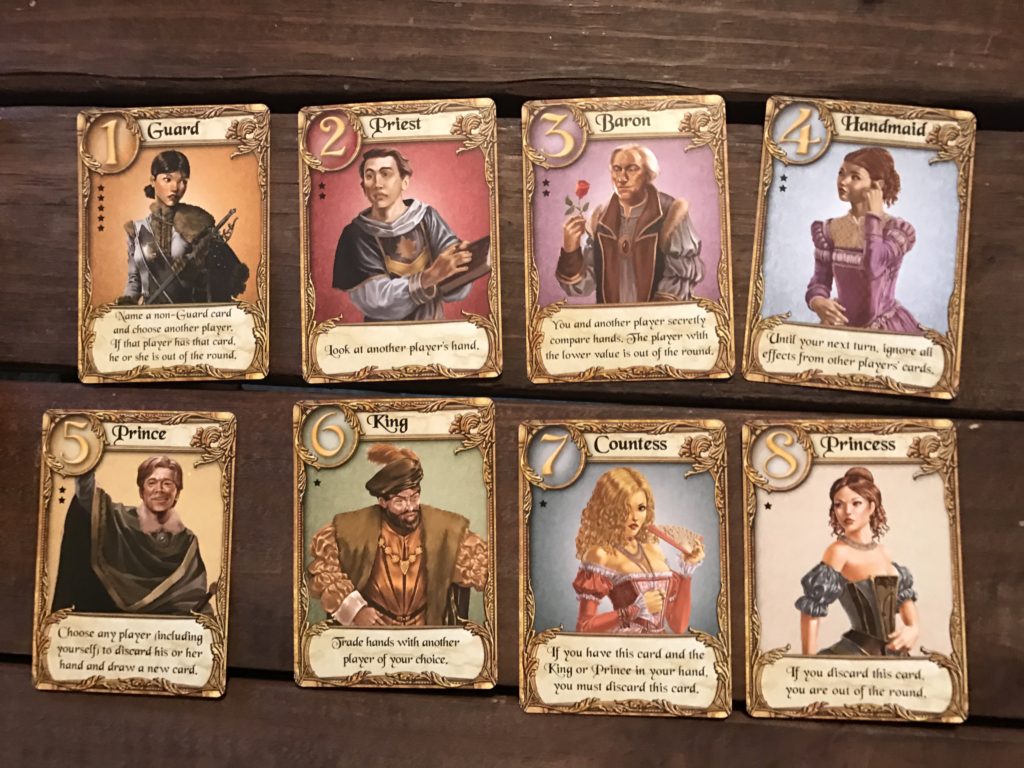
The eight cards in Love Letter are as follows:

  1. Guard. Name a non-Guard card and choose another player. If that player has that card, he or she is out of the round.
  2. Priest. Look at another player’s hand.
  3. Baron. You and another player secretly compare hands. The player with the lower value is out of the round.
  4. Handmaid. Until your next turn, ignore all effects from other players’ cards.
  5. Prince. Choose any player (including yourself) to discard his or her hand and draw a new card.
  6. King. Trade hands with another player of your choice.
  7. Countess. If you have this card and the King or Prince in your hand, you must discard this card.
  8. Princess. If you discard this card, you are out of the round.

The higher your card’s value, the higher your probability of winning the round – a long-term benefit. The lower your card’s value, the higher your probability of hurting other players – a short-term benefit. It’s a very simple trade-off, but one that takes careful thought to manage. I’ll break it down further.

  1. Guard. If you know what someone is holding in their hand, you can knock them right out of the round. Boom. The odds that you’ll know at least one person’s hand are pretty high. However, if you’re holding this at the end of the round, you’re almost certain to lose.
  2. Priest. Information is a valuable currency in this game. This lets you peek at someone’s hand, giving you a chance to maximize the use of the Guard or Baron cards to knock someone out.
  3. Baron. Play this when you’ve got a high card in your hand and you knock someone out. It’s a little risky, though.
  4. Handmaid. Thwart someone’s strategy – purely defensive, but pretty useful.
  5. Prince. If you know someone is holding a high card, this can be a really useful play, but you won’t get many chances to use it in practice.
  6. King. The only reason to use this card at all is if you’re going to get the Countess or Princess out of the deal, which is fairly unlikely. Otherwise, you’re better off holding onto the King.
  7. Countess. This card almost assures you victory if you can hold onto it, but its effect is a liability since it can force you to discard a great card for a lesser one!
  8. Princess. This card wins you the game if you survive to the end of the round, but its effect is a liability. One false move and it’s over for you!

At a price point of $10 on Amazon, this game is worth your attention! This game is excellent for teaching one of the fundamental lessons of game design balance: developing a trade-off. If you’re a designer, buy this and a few other games like it. It’s through studying simplicity that we can create elegant complexity.


What is the board game community?

Posted on 3 CommentsPosted in Philosophy

Ever since I failed to fund my first Kickstarter campaign for War Co., I’ve been very involved in the board game community. My personal favorite hang-out spots within the board game community are Twitter and Meetup groups. That doesn’t even scratch the surface, though. There’s conventions, Instagram, Facebook, the thriving /r/boardgames subreddit, Board Game Geek, and so much more. I’ve noticed that no matter where I go within the community, though, there’s a subject upon which people love to pontificate: what is the board game community?

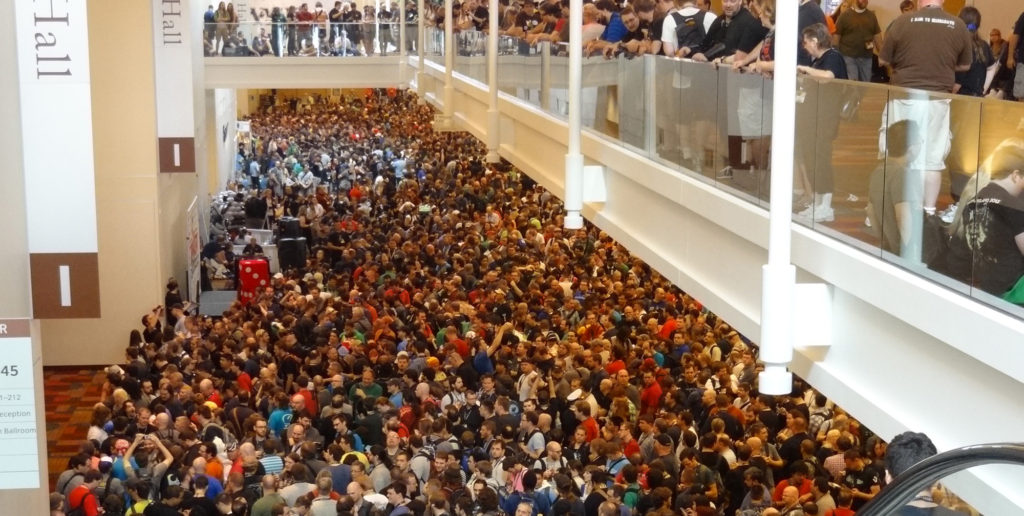
This is Gen Con. We are legion.

Looking for more resources to help you on your board game design journey?
Here you go: no email required!

Like this writing style?
Check out my latest blog on marketing here.

The board game community is huge. If you’re new to design, it’s bigger than you can understand. It’s a billion with a “b” dollar industry, and indicates millions with an “m” individuals who are committed enough to board games to put down dollars. The board game community spans hundreds of websites and social networks, knowing no geographical bounds. It contains people of different ages, genders, religious beliefs, political affilitations, and nationalities.

The board game community is diverse in interests, too. “Board games” is a catch-all term for board games, card games, collectible games, dice games, miniature games, RPGs, and – goodness – I don’t even know what else. The board game community is very loosely defined. It’s you. It’s me. It’s the crowd in the photo above. It’s every board game backer on Kickstarter. It’s everyone who buys Exploding Kittens on Amazon.

The community is tied together literally by a single broad interest.

We all like to game. (Whatever that means…)


The board game community is comprised of tons and tons of small, slightly related niches. If you’re creating something, if you’re selling something, you have to understand this on a gut level. There is not a single game in existence that would please every person in the crowd above. Nor is there a game that could be created to please the entirety of /r/boardgames or every single Kickstarter backer.

Everybody has preferences. Some gamers like short, light games whereas others like heavy, multi-day ones. Some people love elaborate themes (Ameritrash) and some people don’t see a point in having a theme at all (Euro). Some people like certain themes and not others. Hell, you’ll never catch me getting into a Medieval theme, but I’m a sucker for sci-fi. There’s people who feel the exact opposite. Some people game to work out their minds. Some game to socialize.


You are the community.

See the whole as a series of parts.

Imagine others complexly.

Find your niche.

Make something perfect for them.