Minecraft: Using Learning to Make Players Fall in Love

Posted on Leave a commentPosted in Game Breakdown

Minecraft and its unexpected rise were like something out of a movie. In 2009, this rough, glitchy, blocky game was released to the public. In it, you romp around an 8-bit world, fighting monsters and building anything your heart desires. You know, when it wasn’t horribly glitching and doing outright weird stuff.

Looking for more resources to help you on your board game design journey?
Here you go: no email required!

Like this writing style?
Check out my latest blog on marketing here.

The game was gradually refined over a series of pre-alpha, alpha, beta, and release updates. It went from being a hipstery college trend in 2011 to a cultural phenomenon. You probably have a sibling or cousin or child who plays the game on Xbox. We pretty much all do. That’s how massive this game has become.

For the uninitiated, the basic underpinnings of Minecraft are simple. You, the player, are dropped into a world that is infinitely large. You can walk forever and ever and – barring computer failure – the game will continue to generate new environments around you. Every Minecraft world is unique.

If you play the game alone, you have a few minutes to get basic shelter for the terrifying night time. Giant spiders, skeletons, and the dreaded and iconic creepers – who explode on proximity to the player – come out to play. Minecraft is a dangerous world. Yet once you conquer that danger, the game lets you take virtually any material you find in the environment and build with it. You can make elaborate castles, cities with roads and lights, train systems, farms, and more.

There is no objective to Minecraft. You just play. That’s why I think children love it so much. Beneath its unassuming exterior, there is an extraordinarily creative game.

I was really into this game in 2011 and 2012. I was obsessively interested in this game, at one point playing it for 12 hours straight during the finals week of one of my sophomore semesters of college. In fact, I actually made friends with a guy through Minecraft who introduced me to James Masino, the incredible artist who did the work for my first game, War Co

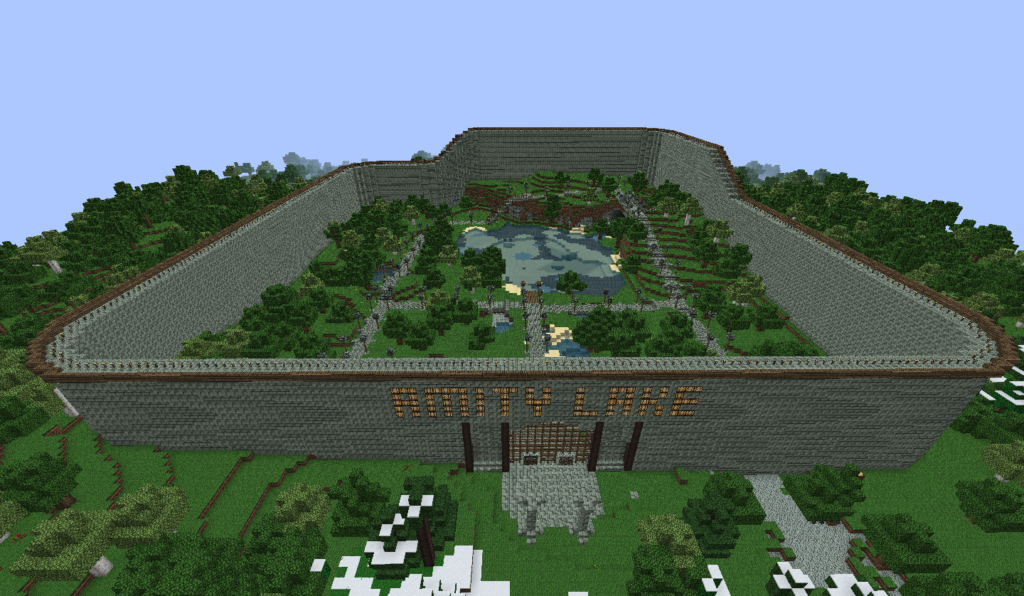
I even used to run a server called Eternal Plains. This is the not-yet populated city of Amity Lake. Those walls are the equivalent of 20 meters high.

It is for this reason that I am breaking down a video game instead of a board game for the second time in this blog’s history. I think we, as board game developers, can learn a lot from this game. Not only is it a good game, but it connects with players on a psychological level that most other games simply can’t.

Minecraft gives players little guidance, teaching players as they interact with the world.

When I started in 2011, Minecraft gave me no advice on how to interact with the world whatsoever. It just dropped me into it and I had to learn everything the hard way. Things have changed a bit and they have short tutorials now, but they still only teach you the basics. All the incredible things Minecraft has to offer – the complex architecture, the terraforming on a godlike scale…well, you learn that on your own. Minecraft shows players how to play through their own actions. There’s no info dump.
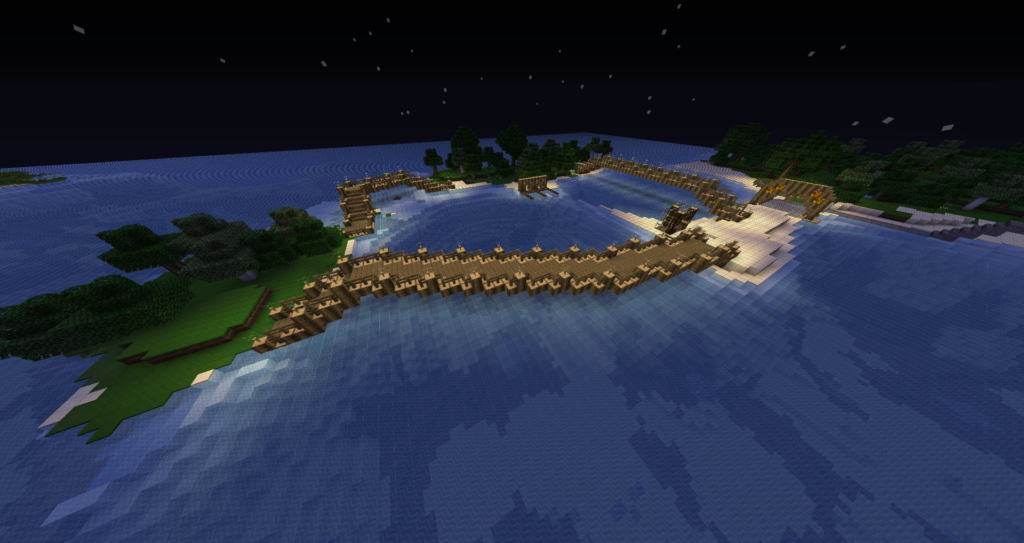
This gives players an incredible sense of achievement as they play. I’ve even got a scholarly article to prove it. Check out this mad knowledge from The Motivational Pull of Video Games: A Self-Determination Theory Approach.

[P]erceived in-game autonomy and competence are associated with game enjoyment, preferences, and changes in well-being pre- to post-play. Competence and autonomy perceptions are also related to the intuitive nature of game controls, and the sense of presence or immersion in participants’ game play experiences.

That is actual, straight-up science saying that autonomy (freedom) and competence (skill-building) are critical parts of gaming that feels good. Heck, you can even find a host of studies that say the same principles apply to the workplace! Furthermore, intuitive controls allow players to build skills and play around freely.

How does this relate to board gaming? I think there’s a few takeaways:

  1. To give people a sense of autonomy, balance your game to where multiple strategies are viable ways of winning.
  2. To give people a sense of competence, make sure your game is understandable on the first or second play. Also make sure your game continues to reward people for playing 5 or 10 or 50 times.
  3. To make your game intuitive, use symbols, hints, and clues instead of preachy verbiage in your rule book.

Players see the effects of their actions on the game world and emotionally connect with the results.

Minecraft is notoriously, brutally hard when you first play. Yet it’s so addictive and rewarding because it gives you ample opportunities to learn and grow. Achievement is both defined by the player and hard-earned because of the forces of environment. All the blocks are so big that when a player sees the result of what they’ve done, they can’t help but emotionally connect with their efforts. Then they keep playing. And playing. And playing. (They call it Minecrack for a reason…)

The success of Minecraft teaches us about ourselves and our behavior. Despite its myriad flaws – the glitchiness, the love-em-or-hate-em graphics – this game remains one of the most perfect ones ever made. It’s the perfect sandbox, the perfect little “microcosm of life”, which is what I think games ultimately are.



3 Simple How-To Guides for Board Game Fulfillment

Posted on 8 CommentsPosted in Know-How

Two weeks ago, I wrote an article on how to prepare for the cost of board game fulfillment. In that article, I also mentioned three other ugly truths about fulfillment that I’ll be talking about today.

Looking for more resources to help you on your board game design journey?
Here you go: no email required!

Like this writing style?
Check out my latest blog on marketing here.

  1. Even domestic fulfillment – packages originating in the United States and going to somewhere else in the United States – can be tricky.
  2. Your international customers might be charged customs or VAT, unless you ship from within their country or region. That means you have to fulfill your games through a third-party distributor OR YOUR CUSTOMERS MIGHT GET CHARGED EXTRA.
  3. Don’t try to fulfill your game on your own if you have more than 200 people to send to at once. Same principle applies if ongoing shipping takes more than an hour or two.

With that in mind, I’ve written how-to guides to help you address these three issues. As with the original article, this advice is targeted at game developers in the United States. However, it might still be helpful even if you’re outside of my country.

How To Ship Low-Volume Domestic Packages Yourself

If you’ve got fewer than about 200 packages to send in the USA, you’re probably better off fulfilling rewards on your own. Services are expensive at low volumes, but critical at higher volumes – we’re talking hundreds of packages OR regularly sending more than 10 packages on a daily basis.

Step 1: Order Flat Rate Mailers from USPS

Our benevolent government has seen fit to provide us with free supplies for shipping mail through the USPS – as long as you’re using priority mail. You still have to pay for postage, which costs quite a bit, but is usually cheaper than anything else (like UPS or DHL). You can order free boxes and mailers on the USPS website in quantities of up to 100 at a time.

Step 2: Buy Packing Supplies from ULINE

If you’re buying boxes, mailers, or bags, there is no better place to look than shipping supply mecca, ULINE. I personally chose to put padded mailers inside of the USPS priority mail padded mailers when I was shipping War Co., so I bought a whole bunch of Kraft yellow mailers from the ULINE store.

Also worth mentioning that if your package is too light to consider priority mail (under 13 ounces) or too bulky to fit in the USPS boxes, ULINE has mailers and boxes of all sorts of sizes. You can use your own boxes and mailers and still print postage.

Step 3: Order Bubble Wrap and Shipping Labels on Amazon

Anything you can’t find on ULINE, you can almost always find on Amazon. A couple of things I found myself buying on Amazon for fulfillment were bubble wrap and handy-dandy adhesive Avery brand shipping labels. I cannot emphasize enough how nice those shipping labels are to have for the next step.

Huge time saver.

Step 4: Make Postage using Stamps.com

If you plan on shipping more than 100 packages at once OR 25 packages per month, I suggest you go to Stamps.com, make an account, and download their software. Full disclosure, it costs about $16/month to maintain an account, but you get a discount of $.70 on every priority package you print postage for, so it pays for itself pretty quickly.

All you have to do is enter the address you want to ship to, enter the weight and size of the package, print the stamp on your nice Avery paper, and stick it on the package. That’s it. Repeat until all your packages are labeled.

You probably don’t need shipping insurance. You will, however, want to buy a cheap postage scale. Your weight estimate needs to be very accurate, and rounded up a bit just in case.

Step 5: Print Scan Sheets and Take Them to the Post Office

Put all of your packages in a box or a bag. Print off the scan sheet that Stamps.com will give you. Take all the packages to the post office. The postal worker will scan your sheet. All you have to do is just hand the packages over the counter. One scan sheet updates the tracking information for all your packages.

How To Find Third-Party Distributors for International Fulfillment

Unless you have only a handful of international packages to send, I strongly suggest you find distributors to help you send packages. Distributors tend to have warehouses in different countries, letting them send packages for way, way, way cheaper than the USPS ever could. Plus, if you send international packages from the US, your international customers might be charged customs or VAT, unless you ship from within their country or region. That means you have to fulfill your games through a third-party distributor OR YOUR CUSTOMERS MIGHT GET CHARGED EXTRA.

Yes, I copied and pasted that statement from above. Yes, that’s the third time it’s been on my blog. That’s how important it is. Kickstarter backers and board game buyers in Canada, Europe, and Australia have come to expect customs-free shipping. You’ll disappoint them if you don’t provide this. It’s an uncomfortable fact, but one you have to work with.

Step 1: Do Your Homework

The best distributors for Kickstarter rewards and board game sales change over time. My specific recommendations below will soon be outdated. Start Googling for fulfillment companies, especially if they fulfill board games. Find names. Look up those names and see what people are saying about them. Rule out the bad eggs before you send your first email.

Step 2: Start an Email Conversation with Distributors

Before you start a serious business relationship with a distributor, email their company. A good chunk of them may not even respond. If that’s the case, you don’t want to do business with them. Pass them by.

If you get a person, start asking about prices. That includes customs, account fees, shipping fees, payment terms, etc. Make sure you have an accurate estimate for the weight and size of your game. Leave no stone unturned. Put everything in an Excel spreadsheet and do some price comparisons. It’s different for every project.

Step 3: Try Some of My Recommendations

Here are some companies I’ve had good experiences with:

  • Games Quest – they do fulfillment worldwide. They’re based in the UK, so their best prices are for Europe.
  • Snakes and Lattes – they do fulfillment for Canada. Their customer service is very friendly and their prices are very reasonable!
  • Aetherworks – they do fulfillment for Australia and New Zealand. If you have a lot of packages going to that area, they’re worth talking to.

How To Find Third-Party Distributors for Domestic Fulfillment

If you’re shipping more than a couple hundred packages in the USA, it’s time to call in the big guns. You need someone shipping USA-bound packages for you. Even if you don’t have many packages to send, this is really good to know about in case your business gets bigger than you expect.

The steps to this are basically the same as above, but here’s a couple of different suggestions:


This is a huge amount of information, and the longest post I’ve ever done. Shipping is very tricky, but if you are detail-oriented and hardworking, you can set up a network to fulfill your wildest dreams. When it’s done right, worldwide fulfillment is downright magical. Like a magician-in-training, though, it’s up to you to learn how the tricks are done.


Machi Koro: Making Players Think about Chance

Posted on 2 CommentsPosted in Game Breakdown

Throw SimCity out the window and grab a fistful of dice. It’s time to play Machi Koro, the dice-building game for 2-4 players that’s captured the attention of thousands of board gamers.  In fact, it was nominated for Spiel des Jahres in 2015 – a huge honor. In the game, you gradually build up the beautiful city of Machi Koro, starting with nothing more than a single die and the desire to create some urban sprawl. The first person to build the four landmarks – Train Station, Shopping Mall, Amusement Park, and Radio Tower – is the winner.

Photo taken by Hubert Figuière and posted on Flickr under the CC BY SA 2.0 license (Source).

Looking for more resources to help you on your board game design journey?
Here you go: no email required!

Like this writing style?
Check out my latest blog on marketing here.

As any good city mayor does, you understand the importance of political expediency that comes from building flashy landmarks. Yet you’re held back by a banal reality: money. It’s all about that dosh. To help you accumulate that sweet, sweet dough, there’s four types of cards that you can buy.

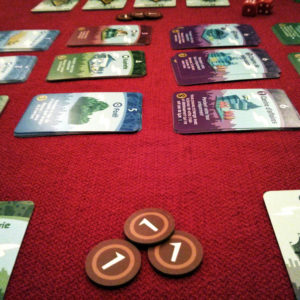
  • Blue cards (Primary Industry) – they earn you money from the bank during anyone’s turn
  • Green cards (Secondary Industry) – they earn you money from the bank during your turn only
  • Red cards (Restaurants) – they earn you money from the player who rolled the dice
  • Purple cards (Major Establishments) – they earn you money from all other players during your turn only

All of these cards are only activated when the dice roll the number at the top of the card. This is what I want to talk about, because it is this mix of probability and strategy that drives Machi Koro.

Players must think about the benefits of duplicates of one card vs. singles of many cards.

Without even going into a detailed analysis of which cards a player may find more attractive, one of the most immediately striking rules in the game is as follows. Getting more duplicates of a card cause the effects of the card to accumulate. The humble Wheat Field nets you one coin every time anybody rolls a 1. However, if you have five of them, suddenly you’ve got five coins at once. How’s that for a bonus check?

This raises a question: is it better to get a whole bunch of different cards OR just duplicates of the same card? The former could leave you with a steady sum of small payments whereas the latter could leave you with a very inconsistent series of massive payments.

This game may be fairly lightweight, and yes – I’ll admit – maybe a bit too luck-based for some folks’ tastes, but the question I raised above kicks off a chain of calculations in the players’ heads. Using the probability of a dice roll of X during your turn/your opponent’s turn assigns a dollar value to each card based on what you expect to happen. In fact, the Machi Koro Wikia gives each card an expected value. You can manipulate the expected value of the money you’ll receive in a turn in the way you choose your cards. This is by no means a heavy game, but it’s pinned to some surprisingly deep questions of value and probability. It’s the sort of stuff you see in economics and finance. But the player doesn’t have to think about this. They just feel it. It’s intuitive.

Players have to think about the benefits of growth vs. theft.

Choosing cards and choosing the quantity of cards is a matter of tactics. Deciding whether you prefer to gain money through organic growth or theft is a matter of strategy. Blue and Green cards earn you money from the bank. Red and Purple cards earn you money from other players.

In a general sense, Blues and Greens will end the game faster since more money gives everybody a better shot at buying landmarks. Reds and Purples redistribute money within the Machi Koro economy, which postpones the end of the game, giving you a slight edge you didn’t have before.

Suffice it to say, if you’re winning, you probably want Blues and Greens padding your wallet with that Machi Dinero. If you’re losing, you probably want Reds and Purples to cut the fatcat capitalists above you down to your size.

Machi Koro is lightweight, simple, pretty, and more strategic than people often give it credit for! Right now it’s $19.29 on Amazon with free shipping. I suggest you check it out if you haven’t already!