
Knowing Your Audience

Posted on 2 CommentsPosted in Know-How

If there’s one piece of business advice I’d like to shout to the heavens, it would be “know your audience!” There are three parts to this: knowing your target audience, knowing your actual audience, and being able to tell where the two are different.

Looking for more resources to help you on your board game design journey?
Here you go: no email required!

Like this writing style?
Check out my latest blog on marketing here.

Spend any amount of time with a marketing expert talking about your business, and you’ll find that one of the first questions they ask – if not the first – is “what’s your target audience?” You must know the answer to that. You need to be able to rattle it off the top of your head without thought.

Your audience is not 18-35 year-old males. Sure, your audience may fit that description, but “18-35 year-old males” is a vague enough description to fit AXE body spray buyers or Bernie Sanders voters. Detail is crucial.

Though they attract a wider audience, Axe body spray doesn't smell as nice as fresh board games.
Though they attract a wider audience, Axe body spray doesn’t smell as nice as fresh board games.

This blog, for example, is aimed at first-time indie board game developer-publishers in their 20s who are looking for “food for thought” and not just tactical advice. That gives me a nice niche to fill – I know who I’m speaking to, how to alter my language to cultural norms, what to say, and what not to say. I talk about the Motivation, Know-How, Philosophy, and Game Breakdowns as if I’m speaking to a first-time indie dev. I use the language that I’d use to talk to someone around my age. I don’t give out really gritty tactical advice like the Kickstarter Lessons blog, I’m going for something different.

As a bonus, general gamers and entrepreneurs can enjoy the blog, too, even if not everything is right up their alley. That’s the magic of a target audience: they’re like an idealized and simplified version of your more diverse actual audience. You can imagine your target audience like one person, and then speak to that person.

Your target isn't the dartboard, but rather the bulls-eye. Though you may score in nearby regions, still aim for your target.
Your target isn’t the dartboard, but rather the bulls-eye. Though you may score in nearby regions, still aim for your target.

Yet even with this understanding, realize that your audience is made of individuals. For example, the folks backing War Co. are primarily big-time board gamers, but there’s a lot of Twitch streamers and a handful of sci-fi fans that fell in love with the game, too. I know this because I take the time to talk to a lot of them and see what makes them tick.

You might find that your actual audience doesn’t match your original expectations. That’s totally normal! Jamey Stegmaier found that the theme of his wine-making board game, Viticulture, attracted a small contingent of wine aficionados. And me? Well, I never really expected to enter the “board game industry” at all! I thought I’d just attract Magic: the Gathering and Yu-Gi-Oh! fans! Jamey amended his beliefs, as did I, and as will you as you learn more.

There’s no substitute for socializing with your audience. You’ll make some friends, and along the way, you’ll get the clarity of purpose and understanding of nuance that you need to succeed.



Find Your Destination by Making Wrong Turns

Posted on 3 CommentsPosted in Motivation

Game development is a notoriously iterative process. Your final game will bear little resemblance to your first draft. The best way to make a good game is to play-test it to death, hammering out all the inconsistencies and problems. This is incredibly time-consuming and disheartening. Don’t let it bother you.

Looking for more resources to help you on your board game design journey?
Here you go: no email required!

Like this writing style?
Check out my latest blog on marketing here.

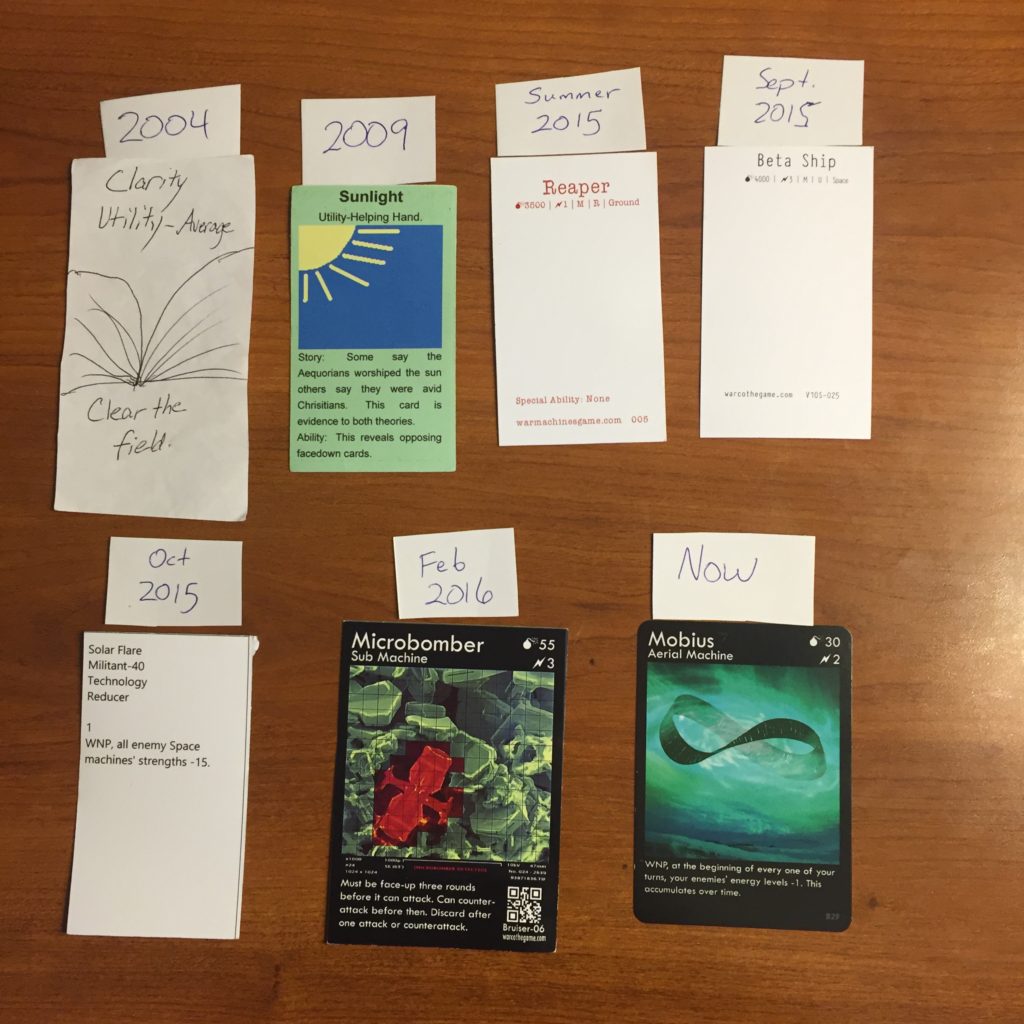
My first game, War Co., went through 17 iterations before its final version was ready for manufacturing. I think I got off easy.

7 of 17 versions of my first game, War Co.
7 of 17 versions of War Co. The earliest versions barely resemble the game today.

Feedback and play-testing is critical. Yet even good play-testers can usually only “point and grunt” at the true underlying problems in your game. Before you play-test your game with other people, make sure you know what type of game you’re trying to create. Come up with the basic feeling you want your game to evoke, an overall objective, and basic constraints that make it hard for players to achieve that objective. All mechanics and art must serve this basic feeling.

Accept that you’re using blunt instruments for a finesse operation. Accept that using limited mechanics can cause unforeseen consequences in gameplay. Accept that people will horribly break your game. Accept that your rules are borderline unreadable. Keep going. These kinks will work themselves out with time, feedback, an open mind ready to receive and process that feedback, and hard work.

hammer-1473924517bef
Play-testing feedback is sometimes like using this for brain surgery.

Take risks. Try things you don’t think will work. Try things that go against traditional wisdom. One of the most praised mechanics of War Co. is that the number of cards you have left is effectively your life. You win by causing your opponent to run out of cards faster than you, often at random. This thwarts the idea of relying on specific combos to win like you might do in games like Magic: the Gathering or Yu-Gi-Oh! because it forces players to abandon the assumption that a certain needed card will eventually turn up. By all means, this shouldn’t have worked. I didn’t expect it to. Even still, I gave it a try and ironed out the details over 7 more versions of the game until it “felt right”.

Trust that you will arrive at your destination. There may be delays. There may be unexpected layovers and missed connecting flights. You may have to circle the airport a few times.

Your destination won’t look like what you first imagined, but it will be better. Strap in and enjoy the journey. It’ll make you a better person. It’ll make your game a better game.