How Far Should Rule Books Go?

Posted on 3 CommentsPosted in Philosophy

The quickest way to turn a brilliant game into a mediocre game is by botching the rule book. The game itself may not be ruined, but the experiences of the players will be dramatically altered for the worse. At first, the purpose of a rule book may seem deceptively clear: it’s supposed to teach players how to play the game. However, anyone who has struggled to create game rules that players can follow with no input from the creator understand that this can be a difficult task. Even as a raw knowledge dump, creating a good rule book is not unlike teaching a computer to make a peanut butter sandwich.

Siri, make me an omelet…

Looking for more resources to help you on your board game design journey?
Here you go: no email required!

Like this writing style?
Check out my latest blog on marketing here.

Many people see game rule books as a way to transfer information to players. I think this is short-sighted. Rule books should go beyond teaching information. They should teach intention as well.

A good rule book uses two techniques to teach intention in addition to information: context and guidance. Context can include a story that explains how different rules fit together. A lot of thematic games use story as a form of context to teach rules. In Twilight Struggle, you know, just from history, that when you’re playing as the USSR, your mission is to screw over the USA whenever you can. Context can also include examples of gameplay. Examples provide excellent context for players to understand how a game is played. In my own game, War Co., I extensively use examples to explain the trickiest concepts.

In the War Co. rule book, I use visual examples to explain how the energy mechanic works.

Guidance goes one step further: it provides practicable advice that players can actually use in the game. For example: “we recommend that you draw as many cards as you can, unless you have a reason not to” OR “try to keep cities from getting more than two disease cubes.”

Rule books need to be thorough, accounting for as many possibilities as they can. Yet they need to remain concise in order to be usable. Some would even argue that the presence of gamers like Rahdo or Watch It Played render traditional rule books obsolete. Yes, it is tempting to create a rule book that provides all information, abundant context, and lots of guidance for strategy and tactical decisions. However, if your rule book is too long, outside sources will end up explaining your game for you. 

Likewise, you want to leave much of your game a mystery. A lot of the appeal of games is that their secrets are slowly unlocked as players discover more tactics and better strategies. By spelling out everything through abundant examples and highly specific advice, you may reduce your game’s longevity!

It’s a tough balance. Yet if you strike this balance, the reward is precious: you can prime a player’s experience. Your rule book is your best chance to not only teach players how to play the game, but to teach them how to have fun playing the game. The purpose of the rule book is to make sure the player has the most fun possible. The tools – information, context, and guidance – should go as far as they must to ensure this, but not any further.


As parting words, here’s six pieces of advice for you when you create your rule book:

  1. Make sure the player knows enough to play the game.
  2. Make your rule book concise.
  3. Leave a little room for mystery.
  4. Make it visual.
  5. Make sure it’s skim-able.
  6. Make sure it’s still useful even if players halfway read it.


How To Prepare for the Cost of Board Game Fulfillment

Posted on 4 CommentsPosted in Know-How

Heads up, this post is targeted at game developers in the United States. However, if you live somewhere else, some of what I say will still be useful.

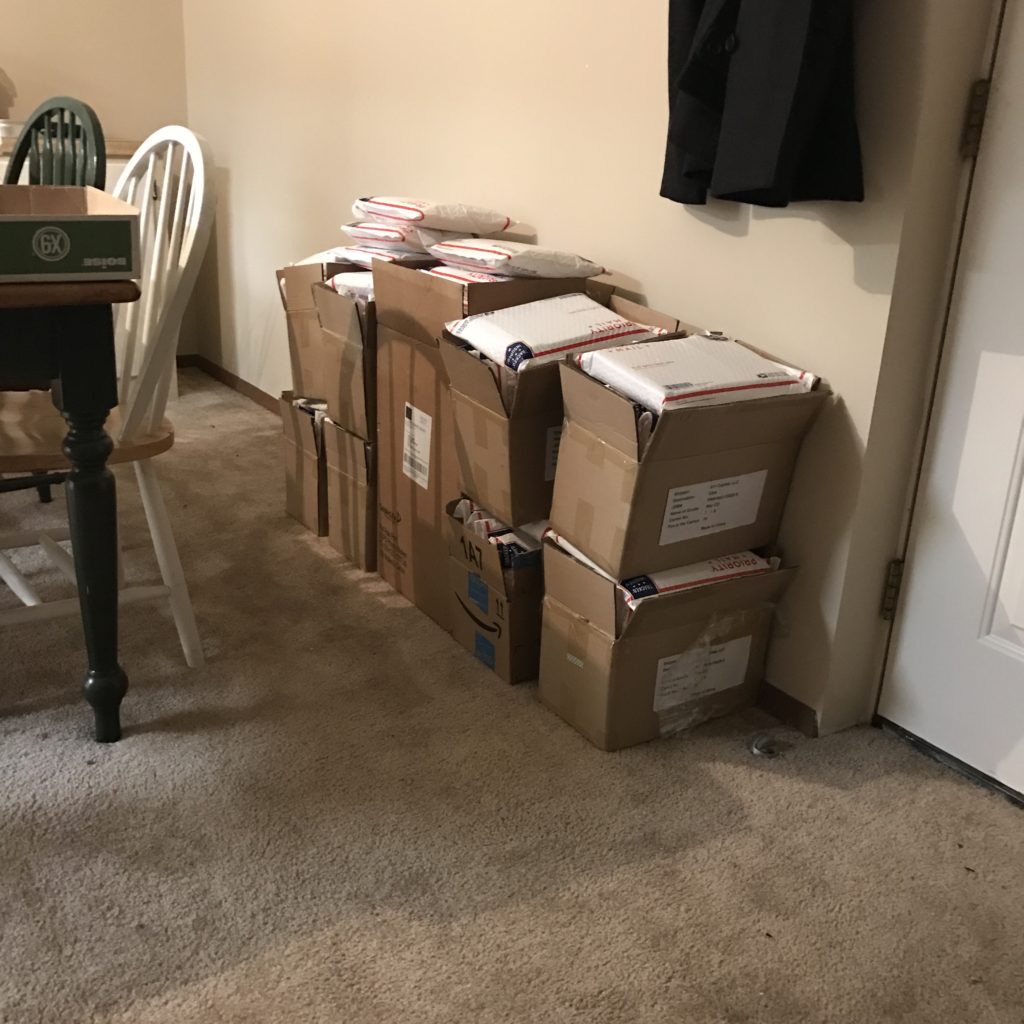
This is about HALF of the War Co. packages shipped in the USA. It was a small campaign.

Looking for more resources to help you on your board game design journey?
Here you go: no email required!

Like this writing style?
Check out my latest blog on marketing here.

Nothing can take the steam out of creator’s sails quite like the brutal reality of trying to ship a physical product all over the world. In fact, I’ve been calling fulfillment a Kickstarter killer since July – before I actually got my Kickstarter off the ground! With that in mind, I’d like to spell out four nasty things about fulfillment that you might not expect.

  1. Fulfillment is expensive.
  2. Even domestic fulfillment – packages originating in the United States and going to somewhere else in the United States – can be tricky.
  3. Your international customers might be charged customs or VAT, unless you ship from within their country or region. That means you have to fulfill your games through a third-party distributor OR YOUR CUSTOMERS MIGHT GET CHARGED EXTRA.
  4. Don’t try to fulfill your game on your own if you have more than 200 people to send to at once. Same principle applies if ongoing shipping takes more than an hour or two.

With those rules in mind, here’s a how-to guide to address the first “nasty thing.” In a couple more weeks, I’ll post three more how-to guides on “nasty things” 2-4.

How To Prepare for the Cost of Fulfillment

Step 1: Respect Complexity

For a moment, consider all the variables that go into fulfilling a Kickstarter campaign. Your manufacturer has to receive parts from their suppliers. They have to send the product to you or your distributors in bulk. Then they have to separate the rewards and send them to individuals. The whole time, your rewards or their component parts are zipping back and forth in boats, cars, planes, and trains. They cross country lines multiple times, go across oceans, fly thousands of miles, and are handled by multiple different companies. Your rewards are subject to all kinds of laws and taxes that you can’t possibly understand all at once. No one can.

That realization sink in yet? Good. Don’t let it dishearten you, because it’s not actually that hard to deal with. You just need to respect the complexity and variability of what you’re doing. That’s the beginning of understanding.

Step 2: Build Accurate Cost Tables Ahead of Time (and Leave Money for Unexpected Expenses)

For domestic shipments, if you’re shipping a lightweight game that can fit in a USPS padded mailer, your shipping cost – with supplies included – will be about $7.50/shipment. For a medium size game, it will cost about $15.00/shipment. For a really big one, you could be looking at $20.00/shipment.

I’m basing these estimates on the cost of USPS priority mailers, which tend to be the cheapest way to send packages in the US. They’re pretty reliable, too. You might lose 1-2% of packages, often due to bad addresses or porch pirates – both of which are not the fault of any shipping company.

International shipping is a little more complex. For that, you need to know the weight of your game and ask for the shipping cost table of any distributors you choose to work with.

Step 3: Build Shipping Cost into Domestic Deliveries, Add Shipping Cost to International Deliveries

If you’re selling online or doing a Kickstarter, you need to be aware that buyers/backers do not understand what goes into shipping. They don’t understand how expensive it is. They just know Amazon Prime gets them packages in 2 days for free.

For this reason, you need to build the shipping cost right into your purchase price/reward price for buyers/backers in the USA. For international buyers/backers, it’s a little more complicated. Figure out the cost your distributors will charge for delivery. Make sure you factor in the price of delivering stock to the distributors, customs paid, account fees, and warehousing fees. Divide that by the amount of inventory you have there. Take that figure and subtract the amount of money it takes to ship to the USA. That’s how much extra you should charge your international backers.

Of course, you need to do two more things if you’re launching a Kickstarter:

  1. Account for the 8-10% cut that Kickstarter and its payment partners will take. That’s 8-10% on every dollar you earn, including that which appears to be set aside for shipping.
  2. Sanity check your shipping prices with backers before you launch. It’s next to impossible to change them after the fact if they’re too high or too low.

This work is heavy on spreadsheets and details, but it will pay off in a big way. The specific numbers and fees you will work with will change with your project, but the steps above can save you a ton of financial headaches.


Be Brave

Posted on Leave a commentPosted in Motivation

If you’re game developer, you’re an entrepreneur. Even if you’re not in it for money, the amount of physical material, labor, and funding you’ll need to organize to make your game real will make you into an entrepreneur. It’s a scary prospect. Game developers, who specialize in creating products people want but don’t need, are especially vulnerable. As you’d expect, the Internet has capitalized on this fear, and is rife with blogs and thinkpieces ceaselessly extolling the virtues of persistence and hard work. Just take a look at these Google results…

Looking for more resources to help you on your board game design journey?
Here you go: no email required!

Like this writing style?
Check out my latest blog on marketing here.

It’s baked into our culture, especially the United States, how important hard work and persistence are. All these articles are just confirming what most of already know. It’s idle palaver that just so happens to generate a lot of ad revenue. You don’t need to learn how to work hard and persist: you need to learn how to be brave.

Hard work and persistence are the results of being highly motivated to do something worthwhile. We procrastinate because we don’t know what to do or because we’re too scared to do it. If it’s direction you lack, here’s a guide on how to find it. If you’re scared, though, that’s a different beast entirely.

If you’re scared, I want you to know two things:

  1. I’m scared, too
  2. You’re not alone.

    I’ve had more sleepless nights than I can count. You’re not the only one who is scared.

Let’s have an honest examination of some of the terrifying things about game development.

  • Any creative endeavor opens up a part of you to the world you probably haven’t shared before.
  • Criticism can take the wind out of your sails really quickly, whether they’re valid complaints or whining from gamers who didn’t read the rules.
  • Critics themselves can be anyone: friends, family, people on the Internet with 50,000 YouTube subscribers, random fly-by-night trolls who go around giving 1s on BoardGameGeek.
  • You’re probably going to be dealing with a lot of money. You might lose quite a bit.
  • If you plan on taking your idea to Kickstarter, that’s a tough road for first timers.
  • You can do everything right and still not please people.
  • You have to learn a lot of skills from scratch, including product testing, marketing and promotion, accounting, and fulfillment.

I could go on for a long time, but you get the point. There’s a lot of very valid things to be afraid of.

Don’t squash your fears. Spell them out. Write them down and look at them with honesty and sober understanding. Being brave is not about being fearless, it’s about understanding the nature of your fears and facing them with dignity. Fear is often what stops us before we reach true greatness. No amount of rattled-off platitudes about putting in 70 hour weeks or doing the same thing for 10 years until you get your big break will sate these fears. We face our fears through self-reflection first and persistence second.

You can do this. I believe in you.